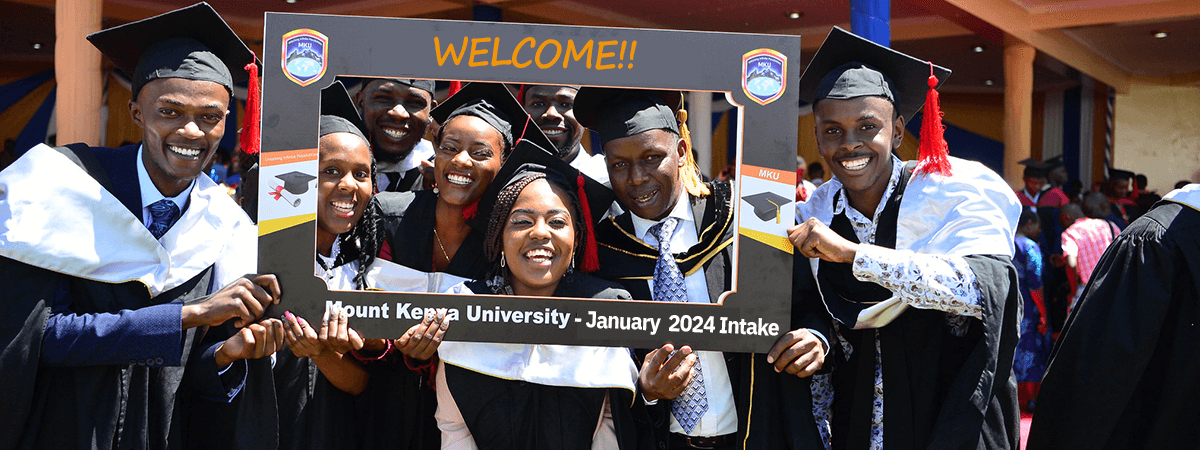
Mount Kenya University organizes career mentorship to help students make informed decisions when choosing courses. KCSE graduates keen to learn more about careers are welcome to visit MKU Campuses/ ODEL centres. This is the beginning of your journey to achieve your career aspirations to become an expert in your respective field of study.
MKU is a Chartered University committed to offering holistic education. MKU has embraced the internationalization agenda of higher education. The University , a research institution dedicated to the generation, dissemination and preservation of knowledge; with 7 regional campuses and 8 Open, Distance and E-Learning (ODEL) Centres; is one of the most culturally diverse universities operating in East Africa and beyond. The University Main campus is located in Thika town, Kenya with other Campuses in Nairobi, Parklands, Mombasa, Nakuru, Eldoret and Meru . The University has ODeL Centres located in Malindi, Kisumu, Kitale, Kakamega, Kisii , Embu, Machakos and Kericho and regional representation in Kigali (Rwanda) ,Kampala in Uganda, Bujumbura in Burundi, Hargeisa in Somaliland and Garowe in Puntland.
Why it is worth to check out Mount Kenya University
Several reasons make MKU a preferred university by students in Kenya and beyond.
- Career guidance: MKU offers free career guidance and mentorship talks. Contact its career counsellors to learn all you need to do to pursue a particular qualification from a specific school.
- Affordable and convenient fees payment: Students are allowed to make flexible fees payment in easy percentage instalments of 40:20:20:20. The Madison Insurance survey on Higher Education rated MKU as the most affordable institution and a leading private university in Kenya in terms of number of programmes on offer and students population.
- Financing : Students are eligible to get HELB loans, CDF Bursaries, MKU Scholarships, foundations, NGOs and external funding from individuals and well-wishers.
- Accreditation: MKU is accredited by the Commission for University Education (CUE) to offer both face-to-face and Open, Distance and Electronic Learning.
- International recognition: The fully chartered University is also ISO 9001:2015 certified. CPS Research International ranked MKU among the top five destinations for international students from Africa and beyond.
- Accessible campuses: Students have a choice to study from any of MKU’s accredited campuses in Kenya and other countries in the region. Hence, MKU offers increased access to, and equity in university education.
- Flexible study options: Flexible study options
- The university promotes access to higher education through its accredited and flexible modes of learning, which include fulltime (Regular), Open, Distance and Electronic Learning, School-based (DIBEL) learning, and part-time (Weekend/Evening). All the programmes offered under these modes are fully accredited by the Commission for University Education (CUE).
- E-Learning facilities: Offering open, distance and e-learning programmes that eliminate residential requirement and reduce costs of education. Wi-Fi internet is accessible in all the campuses. MKU has a strong digital investment in fast internet and cloud services including data storage, e-repository, library support and Microsoft suite.
- Employability: MKU graduates are highly absorbed into the job market. Others become job creators. The University produces highly skilled graduates who are employable across different sectors. Others choose self-employment and create jobs. MKU graduates are among the top 10 most preferred by employers, according to a Corporate Staffing Services Limited Ranking survey.
- Automation: Automation of university processes enhances service delivery. The University has invested in academic resources and ICT infrastructure dedicated towards provision of quality education in its campuses and ODEL centres.
- Superb staff: Qualified and committed faculty and professional staff.
- Academic resources: Well-equipped Science and IT laboratories, Library, Postgraduate Centre and other academic resources.
- International students and staff exchanges: Collaborative student exchanges with international universities such as Clarke University (USA), Makerere University (Uganda), Bonn-Rhein-Sieg University (BRSU) of Applied Sciences, Hochschule Koblenz University of Applied Sciences (Germany) and Vincent Pol University (Poland) enrich teaching and learning at MKU.
- Multicultural diversity: The University recognises and appreciates the diversity of its student population and develops talents through cultural events.
- Community Service/Engagements: Mount Kenya University is committed to carrying out corporate social responsibility based activities that add value to communities.
- Graduate Enterprise Academy: This is a platform to assist students and Alumni become job creators rather than job seekers.
- Rich academic menu
MKU offers a rich academic menu of accredited Programmes ranging from Artisan, Certificate, Diploma, Bachelor’s degree to Postgraduate programmes available at Mount Kenya University.
These are available at MKU 13 schools
- Medical School
- School of Pharmacy
- School of Nursing
- School of Public Health
- School of Clinical Medicine
- School of Business and Economics
- School of Pure and Applied Sciences
- School of Law
- School of Education
- School of Social Sciences
- School of Computing and Informatics
- School of Hospitality, Travel and Tourism Management
- School of Engineering, Energy and the Built Environment















![Canon makes history with 170 Million lenses milestone Canon’s RF/EF lens production exceeds 170 million units, extending its world record in interchangeable lens production Both EF and RF lenses have gained strong support from a wide range of users—from beginners to professionals—leading to steady growth in production volume Canon Inc. announced that, in October 2025, Canon reached a historic milestone of producing a cumulative total of 170 million RF and EF interchangeable lenses for its EOS series, extending its world record for the highest number of interchangeable camera lenses ever produced. The EF lens was introduced in 1987 as the dedicated lens system for Canon’s EOS autofocus single-lens reflex film camera, debuting simultaneously with the EOS system itself. Since their inception, EF lenses have led the industry by incorporating a series of world-first technologies, including the Ultrasonic Motor (USM), Image Stabilizer (IS) technology, and a multilayered Diffractive Optical (DO) element, and have undergone numerous evolutions. In 2018, Canon launched the RF lens series, designed for the EOS R mirrorless camera system, which features a large aperture, short back focus, and high-speed communication system to deliver even higher image quality. The RF and EF lens series lineup now includes a total of 108 models , covering a wide range of focal lengths from ultra-wide 10mm to super-telephoto 1200mm. The series also includes the world’s first VR lens lenses with built-in power zoom suited for video shooting, and even those compatible with power zoom adapters—expanding the scope of creative expression and meeting the diverse needs of users for both still photography and video. EF lens production began at Canon’s Utsunomiya Plant in 1987. Since then, both EF and RF lenses have gained strong support from a wide range of users—from beginners to professionals—leading to steady growth in production volume. Today, Canon manufactures lenses at five sites: Utsunomiya Plant; Canon Inc., Taiwan; Canon Opto (Malaysia) Sdn. Bhd.; Oita Canon Inc.; and Miyazaki Canon Inc. Milestones include 10 million units produced by 1995 and 50 million by 2009. Then in 2014, Canon became the first company in the world to reach 100 million interchangeable camera lenses produced. In October 2025, the company reached 170 million units, leading to the achievement of this world record. The 170 millionth lens produced was the RF 70-200mm F2.8 L IS USM Z. Canon has maintained the No.1 global market share for digital interchangeable-lens cameras for 22 consecutive years since 2003. Moving forward, Canon will continue to refine its proprietary imaging technologies and further strengthen and expand its lens lineup, pioneering new imaging possibilities and contributing to the continued evolution of photographic and video culture. Highlights in the development of the RF/EF Lens Series The EF lens, which was introduced alongside EOS in March 1987, has adopted a variety of world-first technologies, including Image Stabilizer (IS) technology, featured in the EF 75-300mm f/4-5.6 IS USM released in 1995; a multilayered Diffractive Optical (DO) element, used in the EF 400mm f/4 DO IS USM launched in 2001; and Subwavelength Structure Coating (SWC) [7], applied to the EF 24mm f/1.4L II USM released in 2008. In 2021, Canon launched the EOS VR System, a VR video system consisting of a mirrorless camera [8], dedicated lens, and PC software, thereby creating a 3D 180° VR video through an interchangeable lens camera. In 2024, Canon began rolling out a new series of hybrid lenses equipped with iris rings, designed to meet the needs of both still photography and professional video production. For zoom lenses, the company has also launched RF 24-105mm F2.8 L IS USM Z and RF 70-200mm F2.8 L IS USM Z which are compatible with power zoom adapters. For single focus lenses, the company released F1.4 L hybrid prime lens series that unified the size and ring and button position across models. In September 2025, Canon launched RF 85mm F1.4 L VCM, the fifth model in this series, demonstrating that it can meet demands in line with the changing times. [1] Includes EF, EF-S, EF-M, EF Cinema, RF, RF-S, and RF Cinema lenses and extenders. As of October 21, 2025 (according to a survey by Canon) [2] Among SLR cameras (according to a survey by Canon) [3] Number of products sold as of October 22, 2025 (including extenders). The number of lens models for sale is different according to market figures. [4] Focal length is 5.2mm to 1200mm when including VR lenses [5] An interchangeable digital camera lens that enables VR footage with a single camera. Among interchangeable lens digital cameras released as of October 5, 2021 (according to a survey by Canon) [6] Refers to unit share (according to a survey by Canon) [7] A special coating with advanced anti-reflective properties [8] For applicable cameras, please visit the official Canon website *Release dates in this document refer to dates in Japan. Canon Central and North Africa (CCNA) is a division within Canon Middle East FZ LLC (CME), a subsidiary of Canon Europe. The formation of CCNA in 2016 was a strategic step that aimed to enhance Canon’s business within the Africa region - by strengthening Canon’s in-country presence and focus. CCNA also demonstrates Canon’s commitment to operating closer to its customers and meeting their demands in the rapidly evolving African market. Canon has been represented in the African continent for more than 15 years through distributors and partners that have successfully built a solid customer base in the region. CCNA ensures the provision of high quality, technologically advanced products that meet the requirements of Africa’s rapidly evolving marketplace. With over 100 employees, CCNA manages sales and marketing activities across 44 countries in Africa. Canon’s corporate philosophy is Kyosei – ‘living and working together for the common good’. CCNA pursues sustainable business growth, focusing on reducing its own environmental impact and supporting customers to reduce theirs using Canon’s products, solutions and services. At Canon, we are pioneers, constantly redefining the world of imaging for the greater good. Through our technology and our spirit of innovation, we push the bounds of what is possible – helping us to see our world in ways we never have before. We help bring creativity to life, one image at a time. Because when we can see our world, we can transform it for the better.](https://businessinsights.africa/wp-content/uploads/2026/05/1.-Canon-EOS-R50-Mirrorless-Camera-for-Beginners-1024x764-1-100x70.jpg)