Health Cabinet Secretary Mutahi Kagwe is rooting for multi-stakeholder and cross-sectoral partnerships to help catalyse investments and innovations in the health sector in the wake of the corona virus pandemic.
Speaking on Thursday during the 17th health sector intergovernmental consultative forum, which was held virtually, the CS said innovative health financing which involves the mixing or blending of two or more sources to fund a program or activity has proved successful across the globe.
“We are now being forced to develop new flexibilities and expand mandates to match the needs of a pandemic. This means that changes on some health policies that have been evolving for several years as well as the development of new ones will have to be accelerated. Doing this will require a paradigm shift in our approach to resolving healthcare challenges in our country.” Observed the CS.
According to the CS, the most important lesson the country has learnt from the pandemic is the need to articulate what matters most and to prioritize investments.
“Indeed, our experience with the pandemic has opened our eyes to the fact that a majority of Kenyans are only one illness away from a financial crisis. Now that we are increasingly aware of the unpredictable nature of disease, it is critical that we accelerate the implementation of UHC to ensure that our people are cushioned from financial distress due to medical conditions,” said the CS.
The health CS said the national government has prioritized the Universal Health Coverage with a focus on output financing so as to ensure sustainable financing.
“Health Coverage has become the main focus of the Government, being one of the Big Four Agenda items, we need to ensure access to essential services needed for health and well-being through an explicit essential benefit package for the UHC Scheme beneficiaries” Said Kagwe.
Bringing both levels of government together to deliberate and find solutions to critical issues affecting the health sector, according to Kagwe, will ensure all Kenyans access highest standard of health as envisaged in the Constitution.
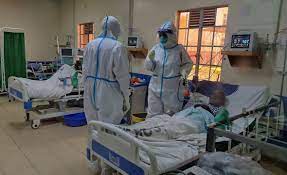
The cabinet secretary lauded the efforts of Counties in combating the corona virus pandemic saying the Ministry of Health will continue to work closely with the devolved units and partners to mitigate the spread of the disease.





![For years, a Johannesburg school's soccer coach did the entire team's laundry himself. Several evenings a week he and the teachers carried the kit home, washed and dried it, and brought it back so the squad had something clean to train in. Their changing room was a bare space with one toilet, a broken mirror and nowhere to store a thing. There was no shortage of talent or commitment – the surroundings just held it all back. Until very recently, this was the reality at Kensington Secondary School. With the help of LG Electronics South Africa (https://apo-opa.co/4eQr5B2), the achiever who chose to fix it was Williams Okpara, the Nigerian goalkeeper who spent more than a decade guarding Orlando Pirates' posts and still holds the club's appearance record. His episode opens Make Life Good, LG's six-part reality series made in partnership with MultiChoice, a Canal+ company, and hosted by Jessica Nkosi. It has aired on Mzansi Magic every Thursday at 19:00 since 11 June, with repeats on Saturdays at 14:00 and Sundays at 09:30. The premise is rare for reality television. No prizes or eliminations, no scandals or tempers boiling over. Instead, six change-makers – or as they are affectionately known by LG as ‘Achievers’ – each return to a cause they already back, and the build teams get 24 hours to remake a space that shapes the people who use it. What connects them is geography as much as generosity: the Achievers come from across the continent, from South Africa, Nigeria and Kenya, yet every organisation they chose sits in a South African community close to their hearts and in need of support. In Lanseria, that community is a safe home and orphanage for babies and young children called LIV Lanseria, backed by Saray Khumalo, the South African mountaineer who became the first Black African woman to summit Everest. Her makeover turned a room with a single two-plate stove into a fully-fledged, working kitchen. A 900 L fridge now holds food for the whole home. A dishwasher returns the hours volunteers used to lose at the sink. A microwave warms a bottle evenly, without the cold spots that catch out a tired caregiver. The appliances follow the problem, which is the guiding principle in bringing together the Achievers, LG and Multichoice to make a difference by using their specialities. The pattern holds at a skills programme for unemployed men, where a small projector gave way to a 100-inch smart display that now runs learning demonstrations and its written theory side by side, as well as an energy-efficient air conditioner that keeps a packed training room usable through the afternoon. In a country that plans its weeks around the unpredictable availability of service delivery, that efficiency is what lets a stretched organisation keep the equipment running once the cameras leave. "Life's Good is our slogan, but this series asks us to prove it where life isn't always easy or fair," says Pennileigh Naidu, Head of Corporate Marketing and PR at LG Electronics South Africa. She frames it as a deliberate move away from product-led marketing. "We didn't want to talk about impact, we wanted to show it. For every organisation, we started with the operational problem they live with daily, then chose the technology that removes it." Her measure of success, she emphasises, is the hours a caregiver gets back and the dignity a working kitchen restores. That is the shift worth a marketer's or a technologist's attention. Corporate social investment has tended to sit off to the side of the business, a cheque written and a photograph taken. Make Life Good folds the impact into the brand and invites the harder question of whether the fridge is still working, and still useful, a year from now. Naidu calls it shared value rather than charity, the point where commercial capability and social relevance stop competing for the same budget. The series reaches viewers in Kenya and Nigeria too, and sits within LG's wider regional storytelling, gathered in its newsroom feature "Beyond the Product". This season, though, the work was South African, room-by-room and need-by-need. The crews have now packed up, and the Achievers have started their work on making changes with more communities. What stays behind in a Lanseria kitchen and a Kensington changing room is quieter and more durable: kit dried overnight, meals prepped faster, an afternoon lesson a full class can finally see. None of it will trend, but all of it will still be working when the next intake of children arrives. Make Life Good – the Achievers and their causes Williams Okpara (Nigeria) – Kensington Secondary School soccer programme, Johannesburg Former Orlando Pirates goalkeeper who holds the club's appearance record and was part of the 1995 CAF Champions League-winning team, and is now Pirates' team manager. Products: 13Kg Front Loader with AI DD™ & Steam+™ in Black Finish (https://apo-opa.co/4wpZzSf); 10kg A+++ Dual Inverter Heat Pump Dryer in Black Finish (https://apo-opa.co/3QEJSrj); LG XBOOM Stage 301 by will.i.am Bluetooth Speaker (http://apo-opa.co/4aG3IsW). Saray Khumalo (South Africa) – LIV Lanseria children's home, Lanseria The first Black African woman to summit Mount Everest and to ski to the South Pole, and founder of the Summits With a Purpose foundation, which raises funds to build libraries in disadvantaged schools. Products: 900L InstaView™ Door-in-Door French Door Fridge with UVnano™ in Black Finish (https://apo-opa.co/3SKr5eF); 42L NeoChef™ Grill Microwave Oven in Stainless Finish (https://apo-opa.co/4f4TweN); 14 Place QuadWash™ Dishwasher with TrueSteam™ in Stainless Finish (https://apo-opa.co/4f4Twvj). Adze Ugah (Nigeria) – Bold Men Skills Program / BBM Foundation Nigerian-born, Johannesburg-based filmmaker, one of the directors of Shaka iLembe, whose feature Sierra's Gold won Best South African Feature Film at the 2024 Durban International Film Festival. Products: 100 inch LG QNED evo AI QNED86 MiniLED 4K 120Hz Smart TV (https://apo-opa.co/4bt52j0); 9.1.5 ch LG Home Cinema Soundbar with Surround Sound and Rear Speakers S95TR (https://apo-opa.co/4wmHX9H); [Wifi] 24k BTU DualCool+ Inverter (https://apo-opa.co/4wt1WDP). Esther Munyi (Kenya) – Botshabelo Babies Home, Midrand Kenyan data and analytics leader, founder of Charmed by Data and former Group Chief Data and Analytics Officer at Sasfin. Products: 900L InstaView™ Door-in-Door French Door Fridge with UVnano™ in Black Finish (https://apo-opa.co/3SKr5eF); 42L NeoChef™ Grill Microwave Oven in Stainless Finish (https://apo-opa.co/4f4TweN); 13Kg Front Loader with AI DD™ & Steam+™ in Black Finish (https://apo-opa.co/4wpZzSf). Thandi Mavata (South Africa) – The House Group, Johannesburg South African entrepreneur, author and women's-empowerment advocate, and founder of the Doek on Fleek movement. Products: 77 inch LG OLED evo AI G5 4K 165Hz Smart TV (https://apo-opa.co/4eUHWTq); [Wifi] 24k BTU DualCool+ Inverter (https://apo-opa.co/4wt1WDP) air conditioner; 3x LG UltraFine 27" QHD IPS Monitor with USB-C (https://apo-opa.co/4buggnp). Perpetual Kendi (Kenya) – Moses Molelekwa Arts Foundation, Tembisa Kenyan Pan-African entrepreneur and communications strategist, founder and CEO of Addleston PR and of the Laute Luxury Wines brand. Products: 65 inch LG QNED evo AI QNED86 MiniLED 4K 120Hz Smart TV (https://apo-opa.co/3QYRg0v); LG MR11 2300W, 4.2Ch AV Receiver System (https://apo-opa.co/4brSdW9).](https://businessinsights.africa/wp-content/uploads/2026/07/OIP-81-218x150.webp "How LG’s ‘Make Life Good’ turned an orphanage’s two-plate stove into a full kitchen")