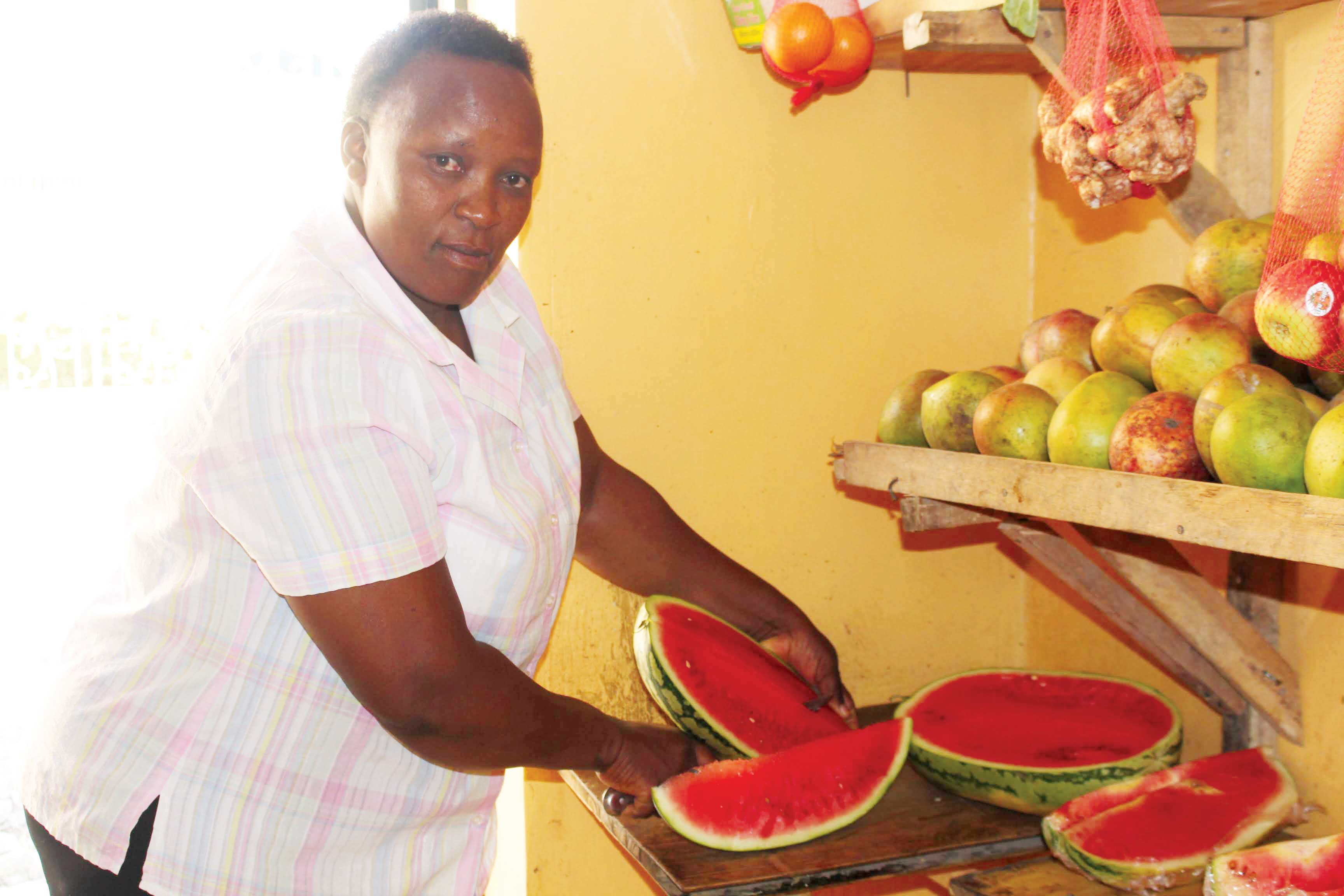

The visionary entrepreneur appreciates the role of banks in financing businesses
By Jeff Korir and Amos Wachira
What started as a small venture has turned into a thriving enterprise for Elizabeth Nyaguthii, a Nairobi based entrepreneur.
In Buruburu phase 2, Taliz Greengrocers is a thriving shop that’s well stocked with a variety of fruits and vegetables. For 12 years, it has been a household name in the Buruburu suburb. It’s known for its fresh farm produce.
On a normal day, Taliz greengrocers is a beehive of activity. Tens of buyers are busy sampling fresh fruits and vegetables on offer as three workers help to sort and process their orders.
Elizabeth started the groceries shop after she saw a need for fresh produce in the area. “I was always shopping for the freshest vegetables and fruits but it was a daunting task. Few people sold fresh produce that’s been sourced directly from the farm,” she says.
That’s why when she opened her first shop in Buruburu phase 2, it was well received by locals who praised her for stocking fresh produce straight from the farm. At that time, she was among the few vendors who were sourcing their vegetables directly from farmers. Most of her competitors were getting their produce from brokers.
“I had the competitive edge and customers flocked to my shop. Even though I was sometimes forced to sell at slightly higher prices because of the transportation costs, customers were happy to get their supplies from my shop as they were certain of its quality.”
Having tasted success with the first shop, Elizabeth set out to establish more shops in different residential areas.
Like with any business, expansion is a capital-intensive affair. Over the years, she was able to set up two more shops, one in Buruburu and another in Nasra estate.
Last year, she found the need to set up a new branch in Nasra estate, where one of her branches was performing well. Elizabeth soon found herself needing additional funds to scale.
“I met the Caritas branch manager for Donholm branch. He analysed my business and saw potential,” she says.
In September last year, she applied for a loan. Once it was disbursed, she used the money to set up her fourth shop. She praises the Caritas microfinance bank team for their prompt services.
Having worked with other banks before, she says that Caritas was different as it walks with its clients. “They are also caring. They walk with you in your entrepreneurial journey. This is not something you get from every other lender out there,” she says. She further says that the bank staff is always at hand to help, sometimes giving out soft loans when one is stuck.
Given the prudent advice that she receives from her loan officers, she says she’s been able to repay her loans on time for the last seven months. “Financial discipline keeps me on track,” she adds.
The four shops employ eight people. Elizabeth says that the business grew exponentially because she insists on quality.
Like any other business, groceries shops have their fair share of challenges.
Given the perishable nature of farm produce, she devised a way of having her contract farmers delivering some of the produce at the retail market in Matikiti, two times a week.
“When I go to buy from their shambas, I strike a deal with them. As they deliver their excess produce to the market, they also deliver my order in bits to make sure I have fresh produce throughout the week.” Elizabeth says that price fluctuations is another challenge that she endures in her line of business. At times, she has to sell her produce on credit, and some customers take advantage of that to varnish without repaying.
She says that getting quality workers is also a challenge.
“Sometimes you wake up only to learn that your workers failed to show up. It destabilizes the business for a few days before you get a replacement.”
Despite the challenges, she has managed to grow her business through sheer hard work and persistence. With consistent quality, her shops continue to grow. It’s this kind of growth that saw her husband, a pharmacist, quitting to join her in the groceries business.
“My husband bought a pickup truck and was willing to help with the logistics. He drives to farms in Meru and other far-flung areas to source for fresh vegetables and fruits.”
With bright prospects, Elizabeth is keen on expanding her business even further. She has set her eyes on opening more branches in a number of estates within Nairobi.
“I want to grow with Caritas microfinance bank.”











![Canon makes history with 170 Million lenses milestone Canon’s RF/EF lens production exceeds 170 million units, extending its world record in interchangeable lens production Both EF and RF lenses have gained strong support from a wide range of users—from beginners to professionals—leading to steady growth in production volume Canon Inc. announced that, in October 2025, Canon reached a historic milestone of producing a cumulative total of 170 million RF and EF interchangeable lenses for its EOS series, extending its world record for the highest number of interchangeable camera lenses ever produced. The EF lens was introduced in 1987 as the dedicated lens system for Canon’s EOS autofocus single-lens reflex film camera, debuting simultaneously with the EOS system itself. Since their inception, EF lenses have led the industry by incorporating a series of world-first technologies, including the Ultrasonic Motor (USM), Image Stabilizer (IS) technology, and a multilayered Diffractive Optical (DO) element, and have undergone numerous evolutions. In 2018, Canon launched the RF lens series, designed for the EOS R mirrorless camera system, which features a large aperture, short back focus, and high-speed communication system to deliver even higher image quality. The RF and EF lens series lineup now includes a total of 108 models , covering a wide range of focal lengths from ultra-wide 10mm to super-telephoto 1200mm. The series also includes the world’s first VR lens lenses with built-in power zoom suited for video shooting, and even those compatible with power zoom adapters—expanding the scope of creative expression and meeting the diverse needs of users for both still photography and video. EF lens production began at Canon’s Utsunomiya Plant in 1987. Since then, both EF and RF lenses have gained strong support from a wide range of users—from beginners to professionals—leading to steady growth in production volume. Today, Canon manufactures lenses at five sites: Utsunomiya Plant; Canon Inc., Taiwan; Canon Opto (Malaysia) Sdn. Bhd.; Oita Canon Inc.; and Miyazaki Canon Inc. Milestones include 10 million units produced by 1995 and 50 million by 2009. Then in 2014, Canon became the first company in the world to reach 100 million interchangeable camera lenses produced. In October 2025, the company reached 170 million units, leading to the achievement of this world record. The 170 millionth lens produced was the RF 70-200mm F2.8 L IS USM Z. Canon has maintained the No.1 global market share for digital interchangeable-lens cameras for 22 consecutive years since 2003. Moving forward, Canon will continue to refine its proprietary imaging technologies and further strengthen and expand its lens lineup, pioneering new imaging possibilities and contributing to the continued evolution of photographic and video culture. Highlights in the development of the RF/EF Lens Series The EF lens, which was introduced alongside EOS in March 1987, has adopted a variety of world-first technologies, including Image Stabilizer (IS) technology, featured in the EF 75-300mm f/4-5.6 IS USM released in 1995; a multilayered Diffractive Optical (DO) element, used in the EF 400mm f/4 DO IS USM launched in 2001; and Subwavelength Structure Coating (SWC) [7], applied to the EF 24mm f/1.4L II USM released in 2008. In 2021, Canon launched the EOS VR System, a VR video system consisting of a mirrorless camera [8], dedicated lens, and PC software, thereby creating a 3D 180° VR video through an interchangeable lens camera. In 2024, Canon began rolling out a new series of hybrid lenses equipped with iris rings, designed to meet the needs of both still photography and professional video production. For zoom lenses, the company has also launched RF 24-105mm F2.8 L IS USM Z and RF 70-200mm F2.8 L IS USM Z which are compatible with power zoom adapters. For single focus lenses, the company released F1.4 L hybrid prime lens series that unified the size and ring and button position across models. In September 2025, Canon launched RF 85mm F1.4 L VCM, the fifth model in this series, demonstrating that it can meet demands in line with the changing times. [1] Includes EF, EF-S, EF-M, EF Cinema, RF, RF-S, and RF Cinema lenses and extenders. As of October 21, 2025 (according to a survey by Canon) [2] Among SLR cameras (according to a survey by Canon) [3] Number of products sold as of October 22, 2025 (including extenders). The number of lens models for sale is different according to market figures. [4] Focal length is 5.2mm to 1200mm when including VR lenses [5] An interchangeable digital camera lens that enables VR footage with a single camera. Among interchangeable lens digital cameras released as of October 5, 2021 (according to a survey by Canon) [6] Refers to unit share (according to a survey by Canon) [7] A special coating with advanced anti-reflective properties [8] For applicable cameras, please visit the official Canon website *Release dates in this document refer to dates in Japan. Canon Central and North Africa (CCNA) is a division within Canon Middle East FZ LLC (CME), a subsidiary of Canon Europe. The formation of CCNA in 2016 was a strategic step that aimed to enhance Canon’s business within the Africa region - by strengthening Canon’s in-country presence and focus. CCNA also demonstrates Canon’s commitment to operating closer to its customers and meeting their demands in the rapidly evolving African market. Canon has been represented in the African continent for more than 15 years through distributors and partners that have successfully built a solid customer base in the region. CCNA ensures the provision of high quality, technologically advanced products that meet the requirements of Africa’s rapidly evolving marketplace. With over 100 employees, CCNA manages sales and marketing activities across 44 countries in Africa. Canon’s corporate philosophy is Kyosei – ‘living and working together for the common good’. CCNA pursues sustainable business growth, focusing on reducing its own environmental impact and supporting customers to reduce theirs using Canon’s products, solutions and services. At Canon, we are pioneers, constantly redefining the world of imaging for the greater good. Through our technology and our spirit of innovation, we push the bounds of what is possible – helping us to see our world in ways we never have before. We help bring creativity to life, one image at a time. Because when we can see our world, we can transform it for the better.](https://businessinsights.africa/wp-content/uploads/2026/05/1.-Canon-EOS-R50-Mirrorless-Camera-for-Beginners-1024x764-1-100x70.jpg)