|
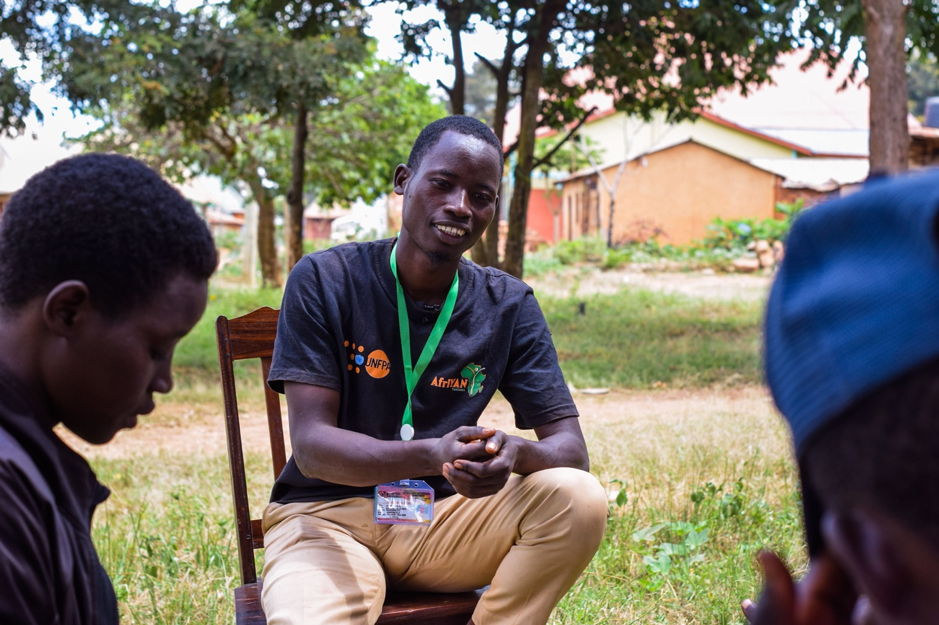
His commitment to a positive impact on his community stems from training he received on sexual reproductive health, gender-based violence and harmful practices, and entrepreneurship
|
![]() Mother-of-two Melania Zambiliti, 21, wanted something more for herself and her family. Living with her in-laws and working as an ad hoc cleaner at a local restaurant where she was given some food, she struggled to make ends meet. When an opportunity presented itself, she welcomed this. The ambitious and determined young woman joined the Upendo group, where she learned economic activities that put her future back on track. As a result, she is able to support her family financially and cater for their basic needs. Through sheer hard work, she managed to save enough money to build her own home, a significant accomplishment that has brought her immense pride and joy. Her transformation from struggling mother to successful provider is a source of inspiration for her community. “After joining the group, I have cultivated sunflower farms and successfully built this house,” she said. But this is not the only area where she has been empowered. “The group has helped me understand reproductive health. Now, I can plan how many children to have and when to have them,” she said. By taking charge of her own fertility with the use of modern contraceptives, she can choose when and how many children to have, while ensuring she is able to provide financially for them. Equipping young people with skills Upendo was started by peer educator Stephen Bikoko, a young man who is passionate about equipping youth in his community with knowledge and skills that empower them. His commitment to a positive impact on his community stems from training he received on sexual reproductive health, gender-based violence and harmful practices, and entrepreneurship. This was provided by Kiota Women’s Health and Development (KIWOHEDE), supported by the Swiss Embassy and UNFPA, the United Nations sexual and reproductive health agency, through the Safeguarding Young People programme. Armed with these new skills, Mr. Bikoko reached out to youth in Kakonko District to empower them. “Since I acquired knowledge on gender-based violence, I succeeded in providing various [training sessions] in the community,” he said. His engaging approach and passion captivated the attention of young people, especially those in informal groups such as motorcycle drivers known as Bodaboda. He soon earned their trust, and became their advocate and mentor. He encouraged them to benefit from loans provided by the local council to youth, women and people with disabilities. Another of Mr. Bikoko’s notable accomplishments was the establishment of the Upendo group, for enthusiastic young people who want to improve their lives through education and entrepreneurial activities. Together, they have engaged in various economic pursuits, including poultry farming, goat keeping and general farming. Through their joint endeavours, the young members have not only acquired an income but also developed a strong sense of unity and purpose. Among them is Melania Zambiliti. Championing sexual and reproductive rights Mr. Bikoko’s efforts have not been limited to Upendo group. In his community, he also promotes sexual and reproductive health education, addresses gender-based violence and harmful practices, and champions the importance of HIV awareness. His articulate interaction with young people has caught the attention and support of community leaders, prompting them to allocate resources towards these crucial issues. Mr. Bikoko’s peer education activities have had a profound impact on young people in Kakonko District. By arming 385 of them with in-depth knowledge of sexual and reproductive health, as well as prevention and response to gender-based violence, harmful practices and HIV, he has empowered them to make informed decisions and live healthier lives. Of these, 167 were high school students, 97 bodaboda (motorcycle drivers), 52 from dispensaries, 54 from local markets, and 15 farmers. The Upendo group has flourished, helping its members to discover their potential and contribute actively to their community’s growth and prosperity. As for Mr. Bikoko, he is proud that he has made a lasting difference in the lives of the young people he serves. The Safeguard Young People programme is being implemented in mainland Tanzania and Zanzibar, with a focus on regions with poor adolescent sexual and reproductive health indicators, including teenage pregnancy, HIV, child marriage and gender inequality. The programme is co-funded by UNFPA and the Embassy of Switzerland in Tanzania. |















![Canon makes history with 170 Million lenses milestone Canon’s RF/EF lens production exceeds 170 million units, extending its world record in interchangeable lens production Both EF and RF lenses have gained strong support from a wide range of users—from beginners to professionals—leading to steady growth in production volume Canon Inc. announced that, in October 2025, Canon reached a historic milestone of producing a cumulative total of 170 million RF and EF interchangeable lenses for its EOS series, extending its world record for the highest number of interchangeable camera lenses ever produced. The EF lens was introduced in 1987 as the dedicated lens system for Canon’s EOS autofocus single-lens reflex film camera, debuting simultaneously with the EOS system itself. Since their inception, EF lenses have led the industry by incorporating a series of world-first technologies, including the Ultrasonic Motor (USM), Image Stabilizer (IS) technology, and a multilayered Diffractive Optical (DO) element, and have undergone numerous evolutions. In 2018, Canon launched the RF lens series, designed for the EOS R mirrorless camera system, which features a large aperture, short back focus, and high-speed communication system to deliver even higher image quality. The RF and EF lens series lineup now includes a total of 108 models , covering a wide range of focal lengths from ultra-wide 10mm to super-telephoto 1200mm. The series also includes the world’s first VR lens lenses with built-in power zoom suited for video shooting, and even those compatible with power zoom adapters—expanding the scope of creative expression and meeting the diverse needs of users for both still photography and video. EF lens production began at Canon’s Utsunomiya Plant in 1987. Since then, both EF and RF lenses have gained strong support from a wide range of users—from beginners to professionals—leading to steady growth in production volume. Today, Canon manufactures lenses at five sites: Utsunomiya Plant; Canon Inc., Taiwan; Canon Opto (Malaysia) Sdn. Bhd.; Oita Canon Inc.; and Miyazaki Canon Inc. Milestones include 10 million units produced by 1995 and 50 million by 2009. Then in 2014, Canon became the first company in the world to reach 100 million interchangeable camera lenses produced. In October 2025, the company reached 170 million units, leading to the achievement of this world record. The 170 millionth lens produced was the RF 70-200mm F2.8 L IS USM Z. Canon has maintained the No.1 global market share for digital interchangeable-lens cameras for 22 consecutive years since 2003. Moving forward, Canon will continue to refine its proprietary imaging technologies and further strengthen and expand its lens lineup, pioneering new imaging possibilities and contributing to the continued evolution of photographic and video culture. Highlights in the development of the RF/EF Lens Series The EF lens, which was introduced alongside EOS in March 1987, has adopted a variety of world-first technologies, including Image Stabilizer (IS) technology, featured in the EF 75-300mm f/4-5.6 IS USM released in 1995; a multilayered Diffractive Optical (DO) element, used in the EF 400mm f/4 DO IS USM launched in 2001; and Subwavelength Structure Coating (SWC) [7], applied to the EF 24mm f/1.4L II USM released in 2008. In 2021, Canon launched the EOS VR System, a VR video system consisting of a mirrorless camera [8], dedicated lens, and PC software, thereby creating a 3D 180° VR video through an interchangeable lens camera. In 2024, Canon began rolling out a new series of hybrid lenses equipped with iris rings, designed to meet the needs of both still photography and professional video production. For zoom lenses, the company has also launched RF 24-105mm F2.8 L IS USM Z and RF 70-200mm F2.8 L IS USM Z which are compatible with power zoom adapters. For single focus lenses, the company released F1.4 L hybrid prime lens series that unified the size and ring and button position across models. In September 2025, Canon launched RF 85mm F1.4 L VCM, the fifth model in this series, demonstrating that it can meet demands in line with the changing times. [1] Includes EF, EF-S, EF-M, EF Cinema, RF, RF-S, and RF Cinema lenses and extenders. As of October 21, 2025 (according to a survey by Canon) [2] Among SLR cameras (according to a survey by Canon) [3] Number of products sold as of October 22, 2025 (including extenders). The number of lens models for sale is different according to market figures. [4] Focal length is 5.2mm to 1200mm when including VR lenses [5] An interchangeable digital camera lens that enables VR footage with a single camera. Among interchangeable lens digital cameras released as of October 5, 2021 (according to a survey by Canon) [6] Refers to unit share (according to a survey by Canon) [7] A special coating with advanced anti-reflective properties [8] For applicable cameras, please visit the official Canon website *Release dates in this document refer to dates in Japan. Canon Central and North Africa (CCNA) is a division within Canon Middle East FZ LLC (CME), a subsidiary of Canon Europe. The formation of CCNA in 2016 was a strategic step that aimed to enhance Canon’s business within the Africa region - by strengthening Canon’s in-country presence and focus. CCNA also demonstrates Canon’s commitment to operating closer to its customers and meeting their demands in the rapidly evolving African market. Canon has been represented in the African continent for more than 15 years through distributors and partners that have successfully built a solid customer base in the region. CCNA ensures the provision of high quality, technologically advanced products that meet the requirements of Africa’s rapidly evolving marketplace. With over 100 employees, CCNA manages sales and marketing activities across 44 countries in Africa. Canon’s corporate philosophy is Kyosei – ‘living and working together for the common good’. CCNA pursues sustainable business growth, focusing on reducing its own environmental impact and supporting customers to reduce theirs using Canon’s products, solutions and services. At Canon, we are pioneers, constantly redefining the world of imaging for the greater good. Through our technology and our spirit of innovation, we push the bounds of what is possible – helping us to see our world in ways we never have before. We help bring creativity to life, one image at a time. Because when we can see our world, we can transform it for the better.](https://businessinsights.africa/wp-content/uploads/2026/05/1.-Canon-EOS-R50-Mirrorless-Camera-for-Beginners-1024x764-1-100x70.jpg)