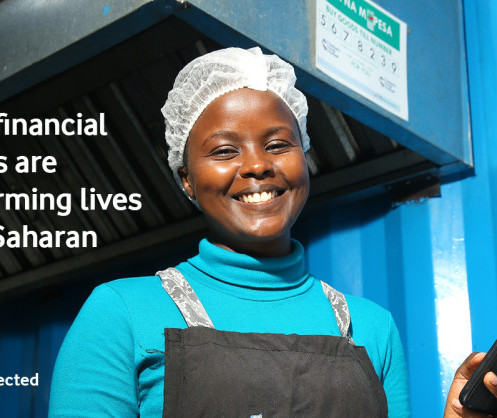

New research from Vodafone Group, Vodacom Group (https://www.Vodacom.com/), Safaricom, and the United Nations Development Programme (UNDP) indicates that the successful deployment and adoption of mobile financial services is associated with a positive impact on GDP growth in developing markets as it helps businesses to reduce cost, access credit to invest, and to connect with consumers that were previously excluded from financial services.
The econometric modelling research[1] – which examined 49 countries in Africa, Asia, and Latin America – found that countries with successful mobile money services had an annual GDP per capita growth rate up to 1 percentage point higher than countries where mobile money platforms had not been successful or not introduced.
Based on previous World Bank research on the relationship between economic growth and reductions in the number of people living in poverty[2], this GDP per capita growth implies that countries with successful mobile money adoption could reduce poverty by around 2.6%.
The analysis was conducted as part of the companies’ Africa.Connected (https://bit.ly/3SGqW6l) campaign, an initiative to drive sustainable development through collaboration and help close the divides that prevent progress in Africa’s key economic sectors. The findings are part of a new research paper, Digital Finance Platforms to Empower All, the fourth research paper developed and released under the Africa.Connected umbrella.
Sitoyo Lopokoiyit, CEO of M-Pesa Africa and Chief Financial Services Officer at Safaricom, said:
Mobile financial services platforms like M-Pesa are vital drivers of financial inclusion in society which can improve individual life chances
“Mobile financial services platforms like M-Pesa are vital drivers of financial inclusion in society which can improve individual life chances and enable enterprises to launch and expand, bringing wealth and jobs into developing economies. There remains though barriers both to accessing platforms – including digital literacy and smartphone accessibility – and to developing them – with an un-level regulatory playing field for non-traditional financial services providers in many countries.”
As part of the Africa.Connected research, consumer surveys were conducted focusing on users of M-Pesa in Kenya and Tanzania, and results were extrapolated to Ghana and Mozambique. A business survey was also conducted in Kenya. The resulting research underpinned the continuing importance of the world’s first mobile money service 15 years after it launched in 2007. The researchers estimated that:
17.6 million current users in the four countries did not have access to any formal financial services before using M-Pesa;
98% of businesses surveyed said that M-Pesa helps them to do business, with the main benefits of M-Pesa being its facilitation of faster and safer payments and enabling the sale of goods and services online; and
95% of businesses surveyed indicated that they use M-Pesa for at least half of their business transactions.
Ulrika Modeer, UN Assistant Secretary-General and Director of the Bureau of External Relations and Advocacy at UNDP, said:
“Financial inclusion is both a pre-condition and a key enabler for meeting many of the UN’s Sustainable Development Goals, including reducing poverty, boosting economic growth, promoting market access and championing investment in key sectors like education, agriculture, and healthcare. But more importantly, it is about putting people at the center, empowering them with more agency over their money and increasing their resilience. Eliminating financial exclusion in Africa, and across the globe, must be a priority if we are to deliver on inclusive, sustainable prosperity for all on a healthy planet.”
Click here to read the full Africa.connected financial inclusion paper:https://bit.ly/3U4QAmp
[1]The econometric model made use of data covering the period 2003 – 2019. More recent data was not included in the modelling due to the effects of the pandemic.
[2] Adams, 2003, Economic Growth, Inequality, and Poverty: Findings from a New Data Set. World Bank. Available online: https://bit.ly/3TQWoQi










![Canon makes history with 170 Million lenses milestone Canon’s RF/EF lens production exceeds 170 million units, extending its world record in interchangeable lens production Both EF and RF lenses have gained strong support from a wide range of users—from beginners to professionals—leading to steady growth in production volume Canon Inc. announced that, in October 2025, Canon reached a historic milestone of producing a cumulative total of 170 million RF and EF interchangeable lenses for its EOS series, extending its world record for the highest number of interchangeable camera lenses ever produced. The EF lens was introduced in 1987 as the dedicated lens system for Canon’s EOS autofocus single-lens reflex film camera, debuting simultaneously with the EOS system itself. Since their inception, EF lenses have led the industry by incorporating a series of world-first technologies, including the Ultrasonic Motor (USM), Image Stabilizer (IS) technology, and a multilayered Diffractive Optical (DO) element, and have undergone numerous evolutions. In 2018, Canon launched the RF lens series, designed for the EOS R mirrorless camera system, which features a large aperture, short back focus, and high-speed communication system to deliver even higher image quality. The RF and EF lens series lineup now includes a total of 108 models , covering a wide range of focal lengths from ultra-wide 10mm to super-telephoto 1200mm. The series also includes the world’s first VR lens lenses with built-in power zoom suited for video shooting, and even those compatible with power zoom adapters—expanding the scope of creative expression and meeting the diverse needs of users for both still photography and video. EF lens production began at Canon’s Utsunomiya Plant in 1987. Since then, both EF and RF lenses have gained strong support from a wide range of users—from beginners to professionals—leading to steady growth in production volume. Today, Canon manufactures lenses at five sites: Utsunomiya Plant; Canon Inc., Taiwan; Canon Opto (Malaysia) Sdn. Bhd.; Oita Canon Inc.; and Miyazaki Canon Inc. Milestones include 10 million units produced by 1995 and 50 million by 2009. Then in 2014, Canon became the first company in the world to reach 100 million interchangeable camera lenses produced. In October 2025, the company reached 170 million units, leading to the achievement of this world record. The 170 millionth lens produced was the RF 70-200mm F2.8 L IS USM Z. Canon has maintained the No.1 global market share for digital interchangeable-lens cameras for 22 consecutive years since 2003. Moving forward, Canon will continue to refine its proprietary imaging technologies and further strengthen and expand its lens lineup, pioneering new imaging possibilities and contributing to the continued evolution of photographic and video culture. Highlights in the development of the RF/EF Lens Series The EF lens, which was introduced alongside EOS in March 1987, has adopted a variety of world-first technologies, including Image Stabilizer (IS) technology, featured in the EF 75-300mm f/4-5.6 IS USM released in 1995; a multilayered Diffractive Optical (DO) element, used in the EF 400mm f/4 DO IS USM launched in 2001; and Subwavelength Structure Coating (SWC) [7], applied to the EF 24mm f/1.4L II USM released in 2008. In 2021, Canon launched the EOS VR System, a VR video system consisting of a mirrorless camera [8], dedicated lens, and PC software, thereby creating a 3D 180° VR video through an interchangeable lens camera. In 2024, Canon began rolling out a new series of hybrid lenses equipped with iris rings, designed to meet the needs of both still photography and professional video production. For zoom lenses, the company has also launched RF 24-105mm F2.8 L IS USM Z and RF 70-200mm F2.8 L IS USM Z which are compatible with power zoom adapters. For single focus lenses, the company released F1.4 L hybrid prime lens series that unified the size and ring and button position across models. In September 2025, Canon launched RF 85mm F1.4 L VCM, the fifth model in this series, demonstrating that it can meet demands in line with the changing times. [1] Includes EF, EF-S, EF-M, EF Cinema, RF, RF-S, and RF Cinema lenses and extenders. As of October 21, 2025 (according to a survey by Canon) [2] Among SLR cameras (according to a survey by Canon) [3] Number of products sold as of October 22, 2025 (including extenders). The number of lens models for sale is different according to market figures. [4] Focal length is 5.2mm to 1200mm when including VR lenses [5] An interchangeable digital camera lens that enables VR footage with a single camera. Among interchangeable lens digital cameras released as of October 5, 2021 (according to a survey by Canon) [6] Refers to unit share (according to a survey by Canon) [7] A special coating with advanced anti-reflective properties [8] For applicable cameras, please visit the official Canon website *Release dates in this document refer to dates in Japan. Canon Central and North Africa (CCNA) is a division within Canon Middle East FZ LLC (CME), a subsidiary of Canon Europe. The formation of CCNA in 2016 was a strategic step that aimed to enhance Canon’s business within the Africa region - by strengthening Canon’s in-country presence and focus. CCNA also demonstrates Canon’s commitment to operating closer to its customers and meeting their demands in the rapidly evolving African market. Canon has been represented in the African continent for more than 15 years through distributors and partners that have successfully built a solid customer base in the region. CCNA ensures the provision of high quality, technologically advanced products that meet the requirements of Africa’s rapidly evolving marketplace. With over 100 employees, CCNA manages sales and marketing activities across 44 countries in Africa. Canon’s corporate philosophy is Kyosei – ‘living and working together for the common good’. CCNA pursues sustainable business growth, focusing on reducing its own environmental impact and supporting customers to reduce theirs using Canon’s products, solutions and services. At Canon, we are pioneers, constantly redefining the world of imaging for the greater good. Through our technology and our spirit of innovation, we push the bounds of what is possible – helping us to see our world in ways we never have before. We help bring creativity to life, one image at a time. Because when we can see our world, we can transform it for the better.](https://businessinsights.africa/wp-content/uploads/2026/05/1.-Canon-EOS-R50-Mirrorless-Camera-for-Beginners-1024x764-1-100x70.jpg)