
By Team Business Insights
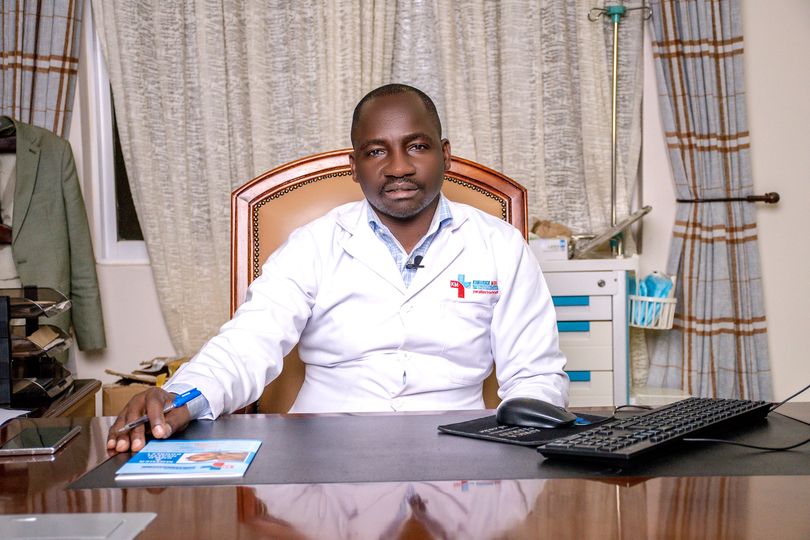
In the tapestry of Kenyan enterprise, few threads shine brighter than those woven by Dr. S.K Nyamu, the founder of Komarock Modern Healthcare. His entrepreneurial rise to the pinnacle of Kenya’s healthcare industry isn’t just a chronicle of corporate ascension, but a multidimensional narrative that combines sheer vision, unwavering resilience and a deep-seated commitment to societal betterment.
From a humble clinic in Komarock estate in Nairobi to the sprawling empire of Komarock Modern Healthcare – among the few hospital chains in the country– Dr Nyamu’s journey offers a masterclass for aspiring entrepreneurs, particularly those seeking to navigate the complex, yet noble, arena of healthcare.
Dr. Nyamu started from the bottom. His journey kicked off in 2004 when working at the Kenyatta National Hospital in his formative years as a medical doctor. “At KNH, I met my former lecturer who introduced me to his friend, who needed a medical professional to sit in his pharmacy to give prescriptions. I took up the job,” he says.
Then living with his cousin in Nairobi’s Dandora estate, he had to move to the then posh neighbourhood of Komarock to start his new job.
Although the pharmacy itself was a small room, Dr. Nyamu was unfazed. He could see patients daily, charging them Kes100 as a consultation fee.
“The first day I made Kes 300, on the second day, I made Kes 900. On the third day, I made nothing but on the fourth day, I made Kes 1200.” Within no time, his medical practice was growing in leaps and bounds, allowing him to pay the Kes100 per day rent for the small room.
The huge Somali population in Komarock back then was his solid base. “Most of my patients needed a genuine person who could treat them first, without demanding to see their money first. That’s how I ended up being their trusted doctor.”
Dr Nyamu remembers a day when one girl in the estate had fought with her sibling, ending up with a deep cut. When the young girl was rushed to his small clinic, they found he was not in. However, the girl refused to be attended to by any other doctor or health facility and opted to wait for him.
To cover emergencies like these when not around the clinic, Dr. Nyamu came up with the idea of bringing on board his first employee, a nurse.
Chris, the nurse, stood in for him whenever he was away. Together, they weathered many storms and built a solid foundation.
His decision to found KMH in 2004 marked the beginning of a monumental journey in healthcare.
As his practice grew, so did the need for space to expand the fledgling business.
“Time for expansion had come and I found a sizable space next door.” In the new space, he opened his first fully-fledged nine-bed hospital with a laboratory, a pharmacy, a maternity wing with three beds and a pediatric ward.
The foundation of Komarock Modern Healthcare was laid with a unique blend of professional expertise and visionary zeal. Given Dr. Nyamu’s expertise as a gynaecologist and his tender care for patients, he was able to gain the trust of a large number of patients. “Sometimes, patients would prefer to wait at the reception for a patient to be discharged so they could get a bed for admission.”
Seeing an unmet need for quality healthcare in the community, Dr.Nyamu smelled an opportunity to take his services beyond the confines of Komarock to serve more patients.
While toying with the idea of an expansion blitz, he met one of his acquaintances, a Mr. Gichana in Komarock, who needed a consultancy service for his son.
“He told me that he had moved his family to a different neighbourhood in the city and was renovating their Komarock home to make way for a supermarket. I asked if they were selling, but he said they weren’t.” After a few days, his friend had a change of heart and called him intending to sell the property to him.
“We met in town and agreed on the price of Kes 3.9million. Even if I had had a good run with the hospital, I did not have that kind of money. With my Kes 1.4 million as a deposit, I approached the S&L division of KCB Bank to ask for a mortgage and I was lucky to get the much-needed funding.”
With the land, his expansion drive got a shot in the hand. He built structures on the piece of land and utilized the old building.
What followed was an expansion drive that saw his healthcare empire take shape.
In 2009, he equipped the hospital and made it a level four facility complete with several services including maternity, X-rays, CT Scan, pediatric, Ultra Sound, male and female wards and a total capacity of 24 beds. Even with a bigger hospital, the number of patients visiting the facility kept rising, prompting him to buy more land for expansion.
In 2011, he bought land in Utawala and built a level five hospital with ICU, Dialysis, CT Scan, Maternity, male and female wards and a total capacity of 150 beds.
His dedication to efficient and compassionate patient care was the cornerstone of his philosophy. Komarock Modern Healthcare’s growth trajectory under his stewardship was meteoric, reshaping the healthcare industry and setting new benchmarks for quality and accessibility.
At the heart of his success lies the audacity to dream big. He saw beyond the fragmented landscape of Kenya’s healthcare sector, envisioning a network of efficient, accessible hospitals catering to the diverse needs of a burgeoning population. This unwavering vision fueled his strategic acquisitions, each calculated move stitching together a patchwork of distinct facilities into a unified, formidable force.
Having built and equipped two hospitals, he had set his eyes on building a healthcare empire, but not before giving back to society. As a young boy, Dr. Nyamu remembers growing up in abject poverty. So dire was his situation that he walked to school barefoot in the hills and valleys of Tharaka Nithi County.
Dr. Nyamu’s success story started with his ability to identify a gap in the healthcare market. He saw the need for more efficient and accessible healthcare facilities and took decisive action to fill this gap. This exemplifies the crucial entrepreneurial skill of market analysis and responding to unmet needs with effective solutions.
Dr. Nyamu exemplifies the principle that with great success comes the responsibility to assist and uplift others.
Going back to Tharaka Nithi county, he built a level five hospital in Kathwana town, the county headquarters of Tharaka Nithi county, to serve the community that brought him up.”The Catholic church in particular majorly paid for my secondary school fees. The community around me saw to it that I went to school.”
“I wore my first pair of shoes when I was joining secondary school,” he remembers nostalgically, recalling that he had carefully placed the pair of shoes inside his metallic box on admission day, not knowing that he was supposed to wear it. Today, he says he can buy any shoe he fancies if only to compensate for the years he walked barefoot.
Dr.Nyamu says that his Kathwana branch gives him lots of joy and contentment. “Sometimes I travel to Tharaka Nithi to see how the facility is transforming healthcare in the county. It has all the facilities that you can find in our Nairobi branches as well as specialists. Although it took him two years for the Kathwana branch to break even, the branch is sorting out a community problem. It is easy to see why it’s been embraced by the community.
The journey of Komarock Modern Healthcare highlights the power of teamwork. Dr Nyamu understood that building a strong team with diverse skills and shared vision was pivotal to his success.
“In our Kathwana branch as well as in all our branches, we have specialists and we work as a team to deliver quality healthcare.”
After building and equipping the Kathwana branch, he then embarked on his next project, the Chuka branch, a behemoth of a hospital which will host 400 beds at full capacity. Built on its land, the hospital is a testament to Dr. Nyamu’s big dream. His next frontier is Kitengela, where a level five hospital is taking shape. “The Kitengela branch will be bigger than Utawala. I trust that we will continue providing cutting-edge care to millions of people in Kenya.”
The story of Komarock Modern Healthcare’s growth reflects a focus on long-term objectives rather than short-term gains. Dr Nyamu had a clear vision for the future and made strategic decisions with this long view in mind. For entrepreneurs, this underscores the importance of patience, perseverance, and aligning actions with a sustainable business model.
This blueprint for success holds invaluable lessons for aspiring entrepreneurs, particularly those navigating the world of healthcare.
Although he has made major strides towards achieving his goals in life and in business, Dr. Nyamu says he’s not yet done.
“I’m yet to realize my dream,” he says, as he heads out to supervise the up-and-coming Kitengela branch.





![Canon makes history with 170 Million lenses milestone Canon’s RF/EF lens production exceeds 170 million units, extending its world record in interchangeable lens production Both EF and RF lenses have gained strong support from a wide range of users—from beginners to professionals—leading to steady growth in production volume Canon Inc. announced that, in October 2025, Canon reached a historic milestone of producing a cumulative total of 170 million RF and EF interchangeable lenses for its EOS series, extending its world record for the highest number of interchangeable camera lenses ever produced. The EF lens was introduced in 1987 as the dedicated lens system for Canon’s EOS autofocus single-lens reflex film camera, debuting simultaneously with the EOS system itself. Since their inception, EF lenses have led the industry by incorporating a series of world-first technologies, including the Ultrasonic Motor (USM), Image Stabilizer (IS) technology, and a multilayered Diffractive Optical (DO) element, and have undergone numerous evolutions. In 2018, Canon launched the RF lens series, designed for the EOS R mirrorless camera system, which features a large aperture, short back focus, and high-speed communication system to deliver even higher image quality. The RF and EF lens series lineup now includes a total of 108 models , covering a wide range of focal lengths from ultra-wide 10mm to super-telephoto 1200mm. The series also includes the world’s first VR lens lenses with built-in power zoom suited for video shooting, and even those compatible with power zoom adapters—expanding the scope of creative expression and meeting the diverse needs of users for both still photography and video. EF lens production began at Canon’s Utsunomiya Plant in 1987. Since then, both EF and RF lenses have gained strong support from a wide range of users—from beginners to professionals—leading to steady growth in production volume. Today, Canon manufactures lenses at five sites: Utsunomiya Plant; Canon Inc., Taiwan; Canon Opto (Malaysia) Sdn. Bhd.; Oita Canon Inc.; and Miyazaki Canon Inc. Milestones include 10 million units produced by 1995 and 50 million by 2009. Then in 2014, Canon became the first company in the world to reach 100 million interchangeable camera lenses produced. In October 2025, the company reached 170 million units, leading to the achievement of this world record. The 170 millionth lens produced was the RF 70-200mm F2.8 L IS USM Z. Canon has maintained the No.1 global market share for digital interchangeable-lens cameras for 22 consecutive years since 2003. Moving forward, Canon will continue to refine its proprietary imaging technologies and further strengthen and expand its lens lineup, pioneering new imaging possibilities and contributing to the continued evolution of photographic and video culture. Highlights in the development of the RF/EF Lens Series The EF lens, which was introduced alongside EOS in March 1987, has adopted a variety of world-first technologies, including Image Stabilizer (IS) technology, featured in the EF 75-300mm f/4-5.6 IS USM released in 1995; a multilayered Diffractive Optical (DO) element, used in the EF 400mm f/4 DO IS USM launched in 2001; and Subwavelength Structure Coating (SWC) [7], applied to the EF 24mm f/1.4L II USM released in 2008. In 2021, Canon launched the EOS VR System, a VR video system consisting of a mirrorless camera [8], dedicated lens, and PC software, thereby creating a 3D 180° VR video through an interchangeable lens camera. In 2024, Canon began rolling out a new series of hybrid lenses equipped with iris rings, designed to meet the needs of both still photography and professional video production. For zoom lenses, the company has also launched RF 24-105mm F2.8 L IS USM Z and RF 70-200mm F2.8 L IS USM Z which are compatible with power zoom adapters. For single focus lenses, the company released F1.4 L hybrid prime lens series that unified the size and ring and button position across models. In September 2025, Canon launched RF 85mm F1.4 L VCM, the fifth model in this series, demonstrating that it can meet demands in line with the changing times. [1] Includes EF, EF-S, EF-M, EF Cinema, RF, RF-S, and RF Cinema lenses and extenders. As of October 21, 2025 (according to a survey by Canon) [2] Among SLR cameras (according to a survey by Canon) [3] Number of products sold as of October 22, 2025 (including extenders). The number of lens models for sale is different according to market figures. [4] Focal length is 5.2mm to 1200mm when including VR lenses [5] An interchangeable digital camera lens that enables VR footage with a single camera. Among interchangeable lens digital cameras released as of October 5, 2021 (according to a survey by Canon) [6] Refers to unit share (according to a survey by Canon) [7] A special coating with advanced anti-reflective properties [8] For applicable cameras, please visit the official Canon website *Release dates in this document refer to dates in Japan. Canon Central and North Africa (CCNA) is a division within Canon Middle East FZ LLC (CME), a subsidiary of Canon Europe. The formation of CCNA in 2016 was a strategic step that aimed to enhance Canon’s business within the Africa region - by strengthening Canon’s in-country presence and focus. CCNA also demonstrates Canon’s commitment to operating closer to its customers and meeting their demands in the rapidly evolving African market. Canon has been represented in the African continent for more than 15 years through distributors and partners that have successfully built a solid customer base in the region. CCNA ensures the provision of high quality, technologically advanced products that meet the requirements of Africa’s rapidly evolving marketplace. With over 100 employees, CCNA manages sales and marketing activities across 44 countries in Africa. Canon’s corporate philosophy is Kyosei – ‘living and working together for the common good’. CCNA pursues sustainable business growth, focusing on reducing its own environmental impact and supporting customers to reduce theirs using Canon’s products, solutions and services. At Canon, we are pioneers, constantly redefining the world of imaging for the greater good. Through our technology and our spirit of innovation, we push the bounds of what is possible – helping us to see our world in ways we never have before. We help bring creativity to life, one image at a time. Because when we can see our world, we can transform it for the better.](https://businessinsights.africa/wp-content/uploads/2026/05/1.-Canon-EOS-R50-Mirrorless-Camera-for-Beginners-1024x764-1-218x150.jpg)


![Canon makes history with 170 Million lenses milestone Canon’s RF/EF lens production exceeds 170 million units, extending its world record in interchangeable lens production Both EF and RF lenses have gained strong support from a wide range of users—from beginners to professionals—leading to steady growth in production volume Canon Inc. announced that, in October 2025, Canon reached a historic milestone of producing a cumulative total of 170 million RF and EF interchangeable lenses for its EOS series, extending its world record for the highest number of interchangeable camera lenses ever produced. The EF lens was introduced in 1987 as the dedicated lens system for Canon’s EOS autofocus single-lens reflex film camera, debuting simultaneously with the EOS system itself. Since their inception, EF lenses have led the industry by incorporating a series of world-first technologies, including the Ultrasonic Motor (USM), Image Stabilizer (IS) technology, and a multilayered Diffractive Optical (DO) element, and have undergone numerous evolutions. In 2018, Canon launched the RF lens series, designed for the EOS R mirrorless camera system, which features a large aperture, short back focus, and high-speed communication system to deliver even higher image quality. The RF and EF lens series lineup now includes a total of 108 models , covering a wide range of focal lengths from ultra-wide 10mm to super-telephoto 1200mm. The series also includes the world’s first VR lens lenses with built-in power zoom suited for video shooting, and even those compatible with power zoom adapters—expanding the scope of creative expression and meeting the diverse needs of users for both still photography and video. EF lens production began at Canon’s Utsunomiya Plant in 1987. Since then, both EF and RF lenses have gained strong support from a wide range of users—from beginners to professionals—leading to steady growth in production volume. Today, Canon manufactures lenses at five sites: Utsunomiya Plant; Canon Inc., Taiwan; Canon Opto (Malaysia) Sdn. Bhd.; Oita Canon Inc.; and Miyazaki Canon Inc. Milestones include 10 million units produced by 1995 and 50 million by 2009. Then in 2014, Canon became the first company in the world to reach 100 million interchangeable camera lenses produced. In October 2025, the company reached 170 million units, leading to the achievement of this world record. The 170 millionth lens produced was the RF 70-200mm F2.8 L IS USM Z. Canon has maintained the No.1 global market share for digital interchangeable-lens cameras for 22 consecutive years since 2003. Moving forward, Canon will continue to refine its proprietary imaging technologies and further strengthen and expand its lens lineup, pioneering new imaging possibilities and contributing to the continued evolution of photographic and video culture. Highlights in the development of the RF/EF Lens Series The EF lens, which was introduced alongside EOS in March 1987, has adopted a variety of world-first technologies, including Image Stabilizer (IS) technology, featured in the EF 75-300mm f/4-5.6 IS USM released in 1995; a multilayered Diffractive Optical (DO) element, used in the EF 400mm f/4 DO IS USM launched in 2001; and Subwavelength Structure Coating (SWC) [7], applied to the EF 24mm f/1.4L II USM released in 2008. In 2021, Canon launched the EOS VR System, a VR video system consisting of a mirrorless camera [8], dedicated lens, and PC software, thereby creating a 3D 180° VR video through an interchangeable lens camera. In 2024, Canon began rolling out a new series of hybrid lenses equipped with iris rings, designed to meet the needs of both still photography and professional video production. For zoom lenses, the company has also launched RF 24-105mm F2.8 L IS USM Z and RF 70-200mm F2.8 L IS USM Z which are compatible with power zoom adapters. For single focus lenses, the company released F1.4 L hybrid prime lens series that unified the size and ring and button position across models. In September 2025, Canon launched RF 85mm F1.4 L VCM, the fifth model in this series, demonstrating that it can meet demands in line with the changing times. [1] Includes EF, EF-S, EF-M, EF Cinema, RF, RF-S, and RF Cinema lenses and extenders. As of October 21, 2025 (according to a survey by Canon) [2] Among SLR cameras (according to a survey by Canon) [3] Number of products sold as of October 22, 2025 (including extenders). The number of lens models for sale is different according to market figures. [4] Focal length is 5.2mm to 1200mm when including VR lenses [5] An interchangeable digital camera lens that enables VR footage with a single camera. Among interchangeable lens digital cameras released as of October 5, 2021 (according to a survey by Canon) [6] Refers to unit share (according to a survey by Canon) [7] A special coating with advanced anti-reflective properties [8] For applicable cameras, please visit the official Canon website *Release dates in this document refer to dates in Japan. Canon Central and North Africa (CCNA) is a division within Canon Middle East FZ LLC (CME), a subsidiary of Canon Europe. The formation of CCNA in 2016 was a strategic step that aimed to enhance Canon’s business within the Africa region - by strengthening Canon’s in-country presence and focus. CCNA also demonstrates Canon’s commitment to operating closer to its customers and meeting their demands in the rapidly evolving African market. Canon has been represented in the African continent for more than 15 years through distributors and partners that have successfully built a solid customer base in the region. CCNA ensures the provision of high quality, technologically advanced products that meet the requirements of Africa’s rapidly evolving marketplace. With over 100 employees, CCNA manages sales and marketing activities across 44 countries in Africa. Canon’s corporate philosophy is Kyosei – ‘living and working together for the common good’. CCNA pursues sustainable business growth, focusing on reducing its own environmental impact and supporting customers to reduce theirs using Canon’s products, solutions and services. At Canon, we are pioneers, constantly redefining the world of imaging for the greater good. Through our technology and our spirit of innovation, we push the bounds of what is possible – helping us to see our world in ways we never have before. We help bring creativity to life, one image at a time. Because when we can see our world, we can transform it for the better.](https://businessinsights.africa/wp-content/uploads/2026/05/1.-Canon-EOS-R50-Mirrorless-Camera-for-Beginners-1024x764-1-100x70.jpg)