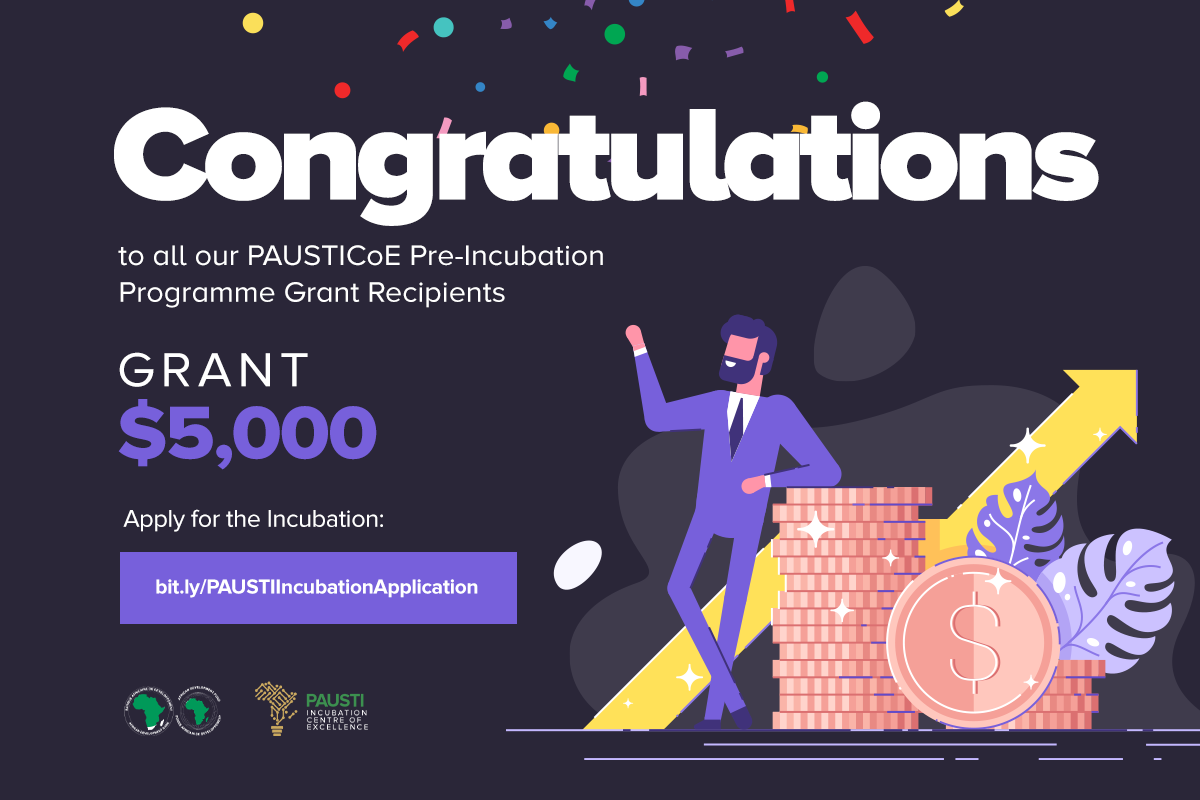
As part of the activities for the PAUSTI Incubation centre, a Pre-Incubation Programme was launched in September following a call for applications. The programme engaged 23 innovators across different PAUSTI Programmes. 16 out of the 23 programme participants were selected to pitch their innovations bidding for an opportunity to receive funding to develop their business models and product prototypes. As the 3-months programme rounded off, 11 innovators were selected. They will each receive up to $5,000 in grant awards and further specialized support through a 6-months incubation programme.
This 3-months Pre-Incubation Programme was designed to help students at PAUSTI refine and validate their innovative ideas. The programme took a design-thinking approach to problem-solving, which adopts a more hands-on approach to prototyping and testing new ideas.
The methodology helped innovators re-frame their problem statements in human-centric ways, generate ideas for solutions that align well with the needs of their potential customers, and therefore increase the chances of success for their solutions. In addition, the innovators got specific training and mentorship from iHub’s extensive, pan-African industry network.






![Kisumu, UN-Habitat sign Ksh2.7bn deal for social housing upgrade The signing ceremony took place in Kisumu, with Governor Prof. Anyang’ Nyong’o representing the county government and UN-Habitat Executive Director in Kenya, Anaclaudia Rossbach, signing on behalf of the UN agency. Under the agreement, both parties commit to jointly implementing the housing upgrade project, which Governor Nyong’o said will primarily target vulnerable groups. “The PINUA programme [is] designed to benefit the most vulnerable members of the community,” Nyong’o said, reaffirming his administration’s commitment to fostering sustainable neighborhoods equipped with essential services. Beginning November 1, 2025, the county government, working with UN-Habitat, will launch pilot projects in Kibuye Estate and Muhoroni Sub-County, based on designs and models developed through extensive public participation. The programme will focus on upgrading informal settlements by providing essential social infrastructure such as schools, sanitation facilities, affordable rental housing, early childhood development centres, and public open spaces. It also supports incremental housing models, allowing families to progressively build and eventually own decent homes. Rossbach emphasized UN-Habitat’s global commitment to driving transformative change in urban areas: “This partnership is crucial in advancing our new strategy, which focuses on improving housing access and digitally transforming informal settlements for everyone.” According to UN-Habitat housing architect Fred Omenya, the pilot phase will begin in January 2026 with the construction of two blocks of 24 housing units in Kibuye Estate.](https://businessinsights.africa/wp-content/uploads/2025/10/About-us-still-25957706200_7ca2db7e5e_k-80x60.jpg)