
With even exotic brands like Bentley, Maserati, and Lamborghini now selling their own super-premium sport-utility vehicles, it seems that a not-so-subtle takeover of the luxury market is manifest destiny. Already, luxury SUVs, especially car-based crossovers, outsell upscale sedans, with compact models being especially popular these days among young up-and-comers and empty nesters alike.
And like their sedan counterparts, it seems some of these upscale people-movers are inherently more reliable over the long haul than others. This may not be as critical a consideration among those who lease a vehicle under a full warranty, but considering the high cost of luxury-vehicle repairs it should be essential to first owners who tend to hold onto their rides well beyond the final car payment, as well as those considering a pre-owned model.
Fortunately, we’ve compiled the following slideshow of what should be the 5 most-reliable luxury SUVs for 2018, based on an aggregate of vehicle durability data compiled by Consumer Reports (based on subscriber surveys), and the market research firm JD Power (based on the experience of nearly 37,000 original owners of three-year-old cars). One caveat: Not all luxury SUVs are rated by either CR or JDP, generally due to a lack of data from limited-production models and recently debuted or redesigned vehicles.

5. BMW X3
Think of the compact BMW X3 as the crossover SUV alternative to the venerable 3 Series sport sedan; while we’d still rather take the latter out for a spin through winding mountain roads, the X3 is no slouch in the handling department, either. It receives an above-average rating for reliability from Consumer Reports, and an average overall score from JD Power, but with an above average ranking for powertrain durability, which is where the proverbial rubber meets the road in terms of potential repair costs.
Another sporty choice than may just be too small for many luxury SUV intenders, the subcompact is nonetheless a more-practical – and did we mention sporty – alternative to an entry-level upscale sedan. It’s rated above average for dependability by both JD Power and Consumer Reports

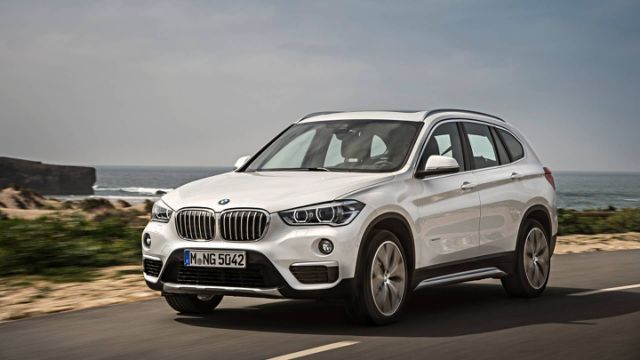
4. BMW X1
Another sporty choice than may just be too small for many luxury SUV intenders, the subcompact BMW X1 is nonetheless a more-practical – and did we mention sporty – alternative to an entry-level upscale sedan. It’s rated above average for dependability by both JD Power and Consumer Reports.
The top seller in the luxury brand’s lineup, the compact was redesigned for 2018 with a fresh look inside and out, and a reasonably sporty, yet still plenty sophisticated, demeanor. Consumer Reports pegs it as being above average for durability, with an average powertrain dependability ranking from JD Power.

Audi Q3 is the crossover SUV equivalent of the A3 sedan, and is every bit as entertaining to drive, but with added headroom, ground clearance, and cargo space. At that it may be too tight a fit on the inside for many shoppers in the luxury market. Still, it’s rated above average for reliability by Consumer Reports and gets top marks in that regard from JD Power.
2. Audi Q3
The Subcompact Audi Q3 is the crossover SUV equivalent of the A3 sedan, and is every bit as entertaining to drive, but with added headroom, ground clearance, and cargo space. At that it may be too tight a fit on the inside for many shoppers in the luxury market. Still, it’s rated above average for reliability by Consumer Reports and gets top marks in that regard from JD Power.

1. Acura RDX
Successfully treading the line between luxurious and sporty, the compact Acura RDX is the division’s best-selling model, and sales are up despite a new model coming for 2019. It’s rated above average for reliability in Consumer Reports’ subscriber surveys, though it comes up as just average in JD Power’s 2018 Vehicle Dependability Study.
This story first appeared in Yahoo News








![Canon makes history with 170 Million lenses milestone Canon’s RF/EF lens production exceeds 170 million units, extending its world record in interchangeable lens production Both EF and RF lenses have gained strong support from a wide range of users—from beginners to professionals—leading to steady growth in production volume Canon Inc. announced that, in October 2025, Canon reached a historic milestone of producing a cumulative total of 170 million RF and EF interchangeable lenses for its EOS series, extending its world record for the highest number of interchangeable camera lenses ever produced. The EF lens was introduced in 1987 as the dedicated lens system for Canon’s EOS autofocus single-lens reflex film camera, debuting simultaneously with the EOS system itself. Since their inception, EF lenses have led the industry by incorporating a series of world-first technologies, including the Ultrasonic Motor (USM), Image Stabilizer (IS) technology, and a multilayered Diffractive Optical (DO) element, and have undergone numerous evolutions. In 2018, Canon launched the RF lens series, designed for the EOS R mirrorless camera system, which features a large aperture, short back focus, and high-speed communication system to deliver even higher image quality. The RF and EF lens series lineup now includes a total of 108 models , covering a wide range of focal lengths from ultra-wide 10mm to super-telephoto 1200mm. The series also includes the world’s first VR lens lenses with built-in power zoom suited for video shooting, and even those compatible with power zoom adapters—expanding the scope of creative expression and meeting the diverse needs of users for both still photography and video. EF lens production began at Canon’s Utsunomiya Plant in 1987. Since then, both EF and RF lenses have gained strong support from a wide range of users—from beginners to professionals—leading to steady growth in production volume. Today, Canon manufactures lenses at five sites: Utsunomiya Plant; Canon Inc., Taiwan; Canon Opto (Malaysia) Sdn. Bhd.; Oita Canon Inc.; and Miyazaki Canon Inc. Milestones include 10 million units produced by 1995 and 50 million by 2009. Then in 2014, Canon became the first company in the world to reach 100 million interchangeable camera lenses produced. In October 2025, the company reached 170 million units, leading to the achievement of this world record. The 170 millionth lens produced was the RF 70-200mm F2.8 L IS USM Z. Canon has maintained the No.1 global market share for digital interchangeable-lens cameras for 22 consecutive years since 2003. Moving forward, Canon will continue to refine its proprietary imaging technologies and further strengthen and expand its lens lineup, pioneering new imaging possibilities and contributing to the continued evolution of photographic and video culture. Highlights in the development of the RF/EF Lens Series The EF lens, which was introduced alongside EOS in March 1987, has adopted a variety of world-first technologies, including Image Stabilizer (IS) technology, featured in the EF 75-300mm f/4-5.6 IS USM released in 1995; a multilayered Diffractive Optical (DO) element, used in the EF 400mm f/4 DO IS USM launched in 2001; and Subwavelength Structure Coating (SWC) [7], applied to the EF 24mm f/1.4L II USM released in 2008. In 2021, Canon launched the EOS VR System, a VR video system consisting of a mirrorless camera [8], dedicated lens, and PC software, thereby creating a 3D 180° VR video through an interchangeable lens camera. In 2024, Canon began rolling out a new series of hybrid lenses equipped with iris rings, designed to meet the needs of both still photography and professional video production. For zoom lenses, the company has also launched RF 24-105mm F2.8 L IS USM Z and RF 70-200mm F2.8 L IS USM Z which are compatible with power zoom adapters. For single focus lenses, the company released F1.4 L hybrid prime lens series that unified the size and ring and button position across models. In September 2025, Canon launched RF 85mm F1.4 L VCM, the fifth model in this series, demonstrating that it can meet demands in line with the changing times. [1] Includes EF, EF-S, EF-M, EF Cinema, RF, RF-S, and RF Cinema lenses and extenders. As of October 21, 2025 (according to a survey by Canon) [2] Among SLR cameras (according to a survey by Canon) [3] Number of products sold as of October 22, 2025 (including extenders). The number of lens models for sale is different according to market figures. [4] Focal length is 5.2mm to 1200mm when including VR lenses [5] An interchangeable digital camera lens that enables VR footage with a single camera. Among interchangeable lens digital cameras released as of October 5, 2021 (according to a survey by Canon) [6] Refers to unit share (according to a survey by Canon) [7] A special coating with advanced anti-reflective properties [8] For applicable cameras, please visit the official Canon website *Release dates in this document refer to dates in Japan. Canon Central and North Africa (CCNA) is a division within Canon Middle East FZ LLC (CME), a subsidiary of Canon Europe. The formation of CCNA in 2016 was a strategic step that aimed to enhance Canon’s business within the Africa region - by strengthening Canon’s in-country presence and focus. CCNA also demonstrates Canon’s commitment to operating closer to its customers and meeting their demands in the rapidly evolving African market. Canon has been represented in the African continent for more than 15 years through distributors and partners that have successfully built a solid customer base in the region. CCNA ensures the provision of high quality, technologically advanced products that meet the requirements of Africa’s rapidly evolving marketplace. With over 100 employees, CCNA manages sales and marketing activities across 44 countries in Africa. Canon’s corporate philosophy is Kyosei – ‘living and working together for the common good’. CCNA pursues sustainable business growth, focusing on reducing its own environmental impact and supporting customers to reduce theirs using Canon’s products, solutions and services. At Canon, we are pioneers, constantly redefining the world of imaging for the greater good. Through our technology and our spirit of innovation, we push the bounds of what is possible – helping us to see our world in ways we never have before. We help bring creativity to life, one image at a time. Because when we can see our world, we can transform it for the better.](https://businessinsights.africa/wp-content/uploads/2026/05/1.-Canon-EOS-R50-Mirrorless-Camera-for-Beginners-1024x764-1-80x60.jpg)