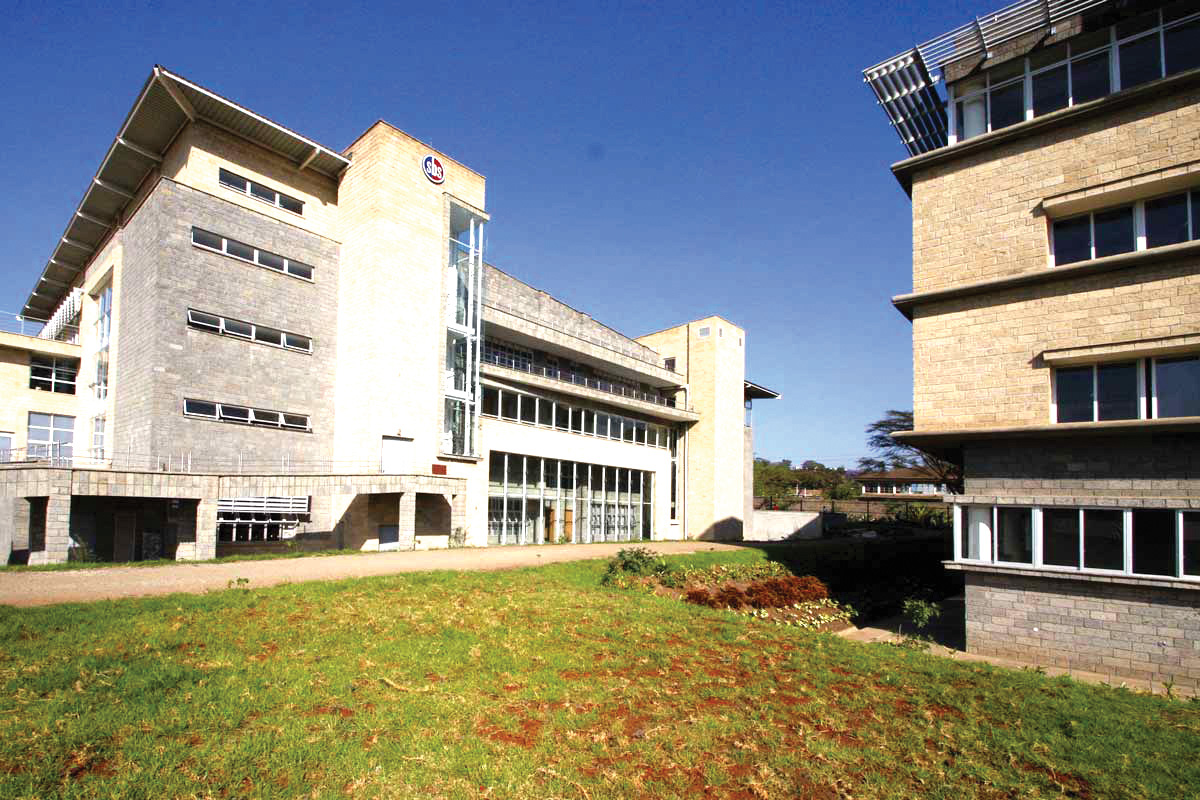

In Kenya, over 70 universities are being called on by the UN Environment Programme and the Kenyan Government to work together and transform their campuses to be the “greenest in the world”. This comes as Strathmore University in Nairobi has put in place one of the greenest campuses in Africa and is offering its support to other Kenyan universities.
“Universities across Africa can run on the power of the sun and set new standards for sustainability,” says Professor da Silva of Strathmore University. “But it’s just not on the roofs of our campuses that we need to take action. We also need to support students to take action in support of the planet in their personal lives.”
Strathmore University set up its own 600-kilowatt photovoltaic grid tie system about five years ago and is not only enjoying free energy from the sun but also selling the excess to Kenya Power under a 20-year contract.
Another initiative on campus involves “green buildings” which utilize natural lighting, water evaporation cooling systems and rain water, making them much more affordable to run than conventional buildings. Students and faculty members are also working together on projects around plastic recycling and using food left-overs to produce natural gas.
Support is now growing to re-establish the Kenya Green University Network in the country with network members including 18 Universities, such as Karatina University, University of Nairobi and Kenyatta University. At a recent meeting, they
committed to a new plan of action including greening campus operations while also enhancing student engagement and learning.
Apart from the desire to go green, many universities are seeing the shift to adopting green technologies as a way to reduce costs and further sustainability. Strathmore University and Karatina University were selected to lead the effort to commit universities to going green.
Working closely with the Ministry of Environment and the National Environment Management Authority, UN Environment will be hosting a Kenya University Summit in the coming months, calling on other Kenyan universities to join the network.
“Kenyan universities not only define the learning and careers of the next generation, they can also shape their behaviours,” says Juliette Biao, Africa Director for UN Environment. “We look forward to supporting the Green University Network to inspire Kenya’s students and to become a point of reference to other universities on the continent.”
campus operations while also enhancing student engagement and learning. Photo by Carina Mutschele.
Professor Aloo-Obudho from Karatina University says: “The [Kenya Green University Network] meeting was timely and has helped me establish relevant contacts to support Karatina University’s solar energy project. Karatina University is at a very advanced stage to implement this project and intends to go 100 per cent solar in the near future.”
The Green University Network in Kenya draws on the African Ministerial Conference on the Environment’s Arusha Declaration “to strengthen environmental education and training and develop an action plan for Africa” and the lessons from Kenya will be shared at a ministerial meeting in South Africa in August.
“I’m particularly happy about the proposed green campuses plan and incorporation of environmental studies into the curriculum,” says Daystar University student Chris Waweru. “This will help students gain the awareness, knowledge and skills needed to impact the environment, thus fast-tracking the movement to a greener and cleaner Kenya.”










![Canon makes history with 170 Million lenses milestone Canon’s RF/EF lens production exceeds 170 million units, extending its world record in interchangeable lens production Both EF and RF lenses have gained strong support from a wide range of users—from beginners to professionals—leading to steady growth in production volume Canon Inc. announced that, in October 2025, Canon reached a historic milestone of producing a cumulative total of 170 million RF and EF interchangeable lenses for its EOS series, extending its world record for the highest number of interchangeable camera lenses ever produced. The EF lens was introduced in 1987 as the dedicated lens system for Canon’s EOS autofocus single-lens reflex film camera, debuting simultaneously with the EOS system itself. Since their inception, EF lenses have led the industry by incorporating a series of world-first technologies, including the Ultrasonic Motor (USM), Image Stabilizer (IS) technology, and a multilayered Diffractive Optical (DO) element, and have undergone numerous evolutions. In 2018, Canon launched the RF lens series, designed for the EOS R mirrorless camera system, which features a large aperture, short back focus, and high-speed communication system to deliver even higher image quality. The RF and EF lens series lineup now includes a total of 108 models , covering a wide range of focal lengths from ultra-wide 10mm to super-telephoto 1200mm. The series also includes the world’s first VR lens lenses with built-in power zoom suited for video shooting, and even those compatible with power zoom adapters—expanding the scope of creative expression and meeting the diverse needs of users for both still photography and video. EF lens production began at Canon’s Utsunomiya Plant in 1987. Since then, both EF and RF lenses have gained strong support from a wide range of users—from beginners to professionals—leading to steady growth in production volume. Today, Canon manufactures lenses at five sites: Utsunomiya Plant; Canon Inc., Taiwan; Canon Opto (Malaysia) Sdn. Bhd.; Oita Canon Inc.; and Miyazaki Canon Inc. Milestones include 10 million units produced by 1995 and 50 million by 2009. Then in 2014, Canon became the first company in the world to reach 100 million interchangeable camera lenses produced. In October 2025, the company reached 170 million units, leading to the achievement of this world record. The 170 millionth lens produced was the RF 70-200mm F2.8 L IS USM Z. Canon has maintained the No.1 global market share for digital interchangeable-lens cameras for 22 consecutive years since 2003. Moving forward, Canon will continue to refine its proprietary imaging technologies and further strengthen and expand its lens lineup, pioneering new imaging possibilities and contributing to the continued evolution of photographic and video culture. Highlights in the development of the RF/EF Lens Series The EF lens, which was introduced alongside EOS in March 1987, has adopted a variety of world-first technologies, including Image Stabilizer (IS) technology, featured in the EF 75-300mm f/4-5.6 IS USM released in 1995; a multilayered Diffractive Optical (DO) element, used in the EF 400mm f/4 DO IS USM launched in 2001; and Subwavelength Structure Coating (SWC) [7], applied to the EF 24mm f/1.4L II USM released in 2008. In 2021, Canon launched the EOS VR System, a VR video system consisting of a mirrorless camera [8], dedicated lens, and PC software, thereby creating a 3D 180° VR video through an interchangeable lens camera. In 2024, Canon began rolling out a new series of hybrid lenses equipped with iris rings, designed to meet the needs of both still photography and professional video production. For zoom lenses, the company has also launched RF 24-105mm F2.8 L IS USM Z and RF 70-200mm F2.8 L IS USM Z which are compatible with power zoom adapters. For single focus lenses, the company released F1.4 L hybrid prime lens series that unified the size and ring and button position across models. In September 2025, Canon launched RF 85mm F1.4 L VCM, the fifth model in this series, demonstrating that it can meet demands in line with the changing times. [1] Includes EF, EF-S, EF-M, EF Cinema, RF, RF-S, and RF Cinema lenses and extenders. As of October 21, 2025 (according to a survey by Canon) [2] Among SLR cameras (according to a survey by Canon) [3] Number of products sold as of October 22, 2025 (including extenders). The number of lens models for sale is different according to market figures. [4] Focal length is 5.2mm to 1200mm when including VR lenses [5] An interchangeable digital camera lens that enables VR footage with a single camera. Among interchangeable lens digital cameras released as of October 5, 2021 (according to a survey by Canon) [6] Refers to unit share (according to a survey by Canon) [7] A special coating with advanced anti-reflective properties [8] For applicable cameras, please visit the official Canon website *Release dates in this document refer to dates in Japan. Canon Central and North Africa (CCNA) is a division within Canon Middle East FZ LLC (CME), a subsidiary of Canon Europe. The formation of CCNA in 2016 was a strategic step that aimed to enhance Canon’s business within the Africa region - by strengthening Canon’s in-country presence and focus. CCNA also demonstrates Canon’s commitment to operating closer to its customers and meeting their demands in the rapidly evolving African market. Canon has been represented in the African continent for more than 15 years through distributors and partners that have successfully built a solid customer base in the region. CCNA ensures the provision of high quality, technologically advanced products that meet the requirements of Africa’s rapidly evolving marketplace. With over 100 employees, CCNA manages sales and marketing activities across 44 countries in Africa. Canon’s corporate philosophy is Kyosei – ‘living and working together for the common good’. CCNA pursues sustainable business growth, focusing on reducing its own environmental impact and supporting customers to reduce theirs using Canon’s products, solutions and services. At Canon, we are pioneers, constantly redefining the world of imaging for the greater good. Through our technology and our spirit of innovation, we push the bounds of what is possible – helping us to see our world in ways we never have before. We help bring creativity to life, one image at a time. Because when we can see our world, we can transform it for the better.](https://businessinsights.africa/wp-content/uploads/2026/05/1.-Canon-EOS-R50-Mirrorless-Camera-for-Beginners-1024x764-1-100x70.jpg)