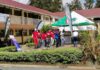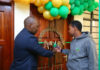
For many learners in Turkana County, going to school is about more than sitting in a classroom and listening to a teacher. It is a journey of determination, one that often means overcoming poverty, long distances, cultural expectations and other challenges that threaten to keep them out of school.But across several schools visited recently, there was something different in the air. There was a renewed sense of excitement among learners.Improved learning facilities, school feeding programmes, low-cost boarding facilities, scholarships and better support for schools are giving learners a reason to believe that their dreams are within reach.The changes are being supported through investments under the Kenya Primary Education Equity in Learning (KPEEL) and Secondary Education Equity and Quality Improvement Program (SEEQIP), programmes designed to address some of the barriers that have historically limited access to quality education, particularly in disadvantaged communities.A joint team from the Ministry of Education, the World Bank and the Global Partnership for Education recently travelled across Turkana County to assess the implementation of the interventions and, importantly, listen to the experiences of the school communities benefiting from them.Among the interventions assessed were School Improvement Plans (SIPs), low-cost boarding facilities, school feeding programmes, Elimu Scholarships and the construction of science laboratories.For the learners, however, these investments are not simply projects on paper. They are changes they can see, feel and experience every day.A meal at school can mean a child no longer has to struggle through lessons on an empty stomach. A boarding facility can bring a school closer to a learner who would otherwise have to travel long distances every day. A scholarship can keep a child in school when financial hardship threatens to bring their education to an early end. And a better-equipped classroom or laboratory can transform how a learner sees their own future.“These field missions give us a clearer understanding of the realities on the ground,” said Esohe Eigbike, Country Engagement Lead at the Global Partnership for Education.She noted that while the mission encountered challenges facing schools and learners, it also witnessed encouraging signs that the investments are beginning to make a difference.“The increased learner morale shows the value of investing in their learning environment and overall educational experience,” she said.The gains, however, are being made against a difficult backdrop. Turkana is vast, and many families continue to face economic hardships that can make education difficult to sustain. The delegation heard that some learners are being drawn into gold-mining activities, while early marriages and teenage pregnancies continue to interrupt the education of girls.For a child growing up in such circumstances, staying in school can require more than academic ability. It requires support from the family, the community, teachers and government.This is why Ruth Charo, Senior Education Specialist at the World Bank, called for stronger community-level advocacy to complement the investments being made in schools.She proposed a coordinated approach bringing together County Commissioners, National Government Administration Officers, County Directors of Education, the Teachers Service Commission and other education stakeholders.The objective is simple: to ensure that challenges keeping children away from school are identified and addressed before they permanently derail their education.“Working together, we can address the challenges that continue to keep learners away from school,” she said.For education officials, the investment in infrastructure must also translate into facilities that are safe, durable and fit for purpose.Elijah Mungai, Head of the Directorate of Project Coordination and Delivery, emphasised that quality assurance must remain central to the implementation of education projects.“Quality assurance must remain at the centre of every stage of delivery to ensure that the facilities and interventions meet the required standards and provide lasting benefits to our learners,” he said.Turkana County Director of Education, Dr. Henry Lubanga, said the county would work closely with the Department of Public Works to ensure that infrastructure projects meet approved designs, quality and safety standards.KPEEL is supporting efforts to improve access, equity and learning outcomes in primary education, while SEEQIP is strengthening secondary education through investments in quality, equity, infrastructure and learning environments.These may appear to be small changes individually. But for a learner whose education has always been uncertain, they can make the difference between dropping out and staying in school.The Turkana mission was part of a wider national exercise, with Ministry of Education, World Bank and Global Partnership for Education teams visiting 17 other counties to assess similar interventions.The visits are intended to strengthen accountability, identify emerging challenges and ensure that investments under KPEEL and SEEQIP deliver what matters most: better learning environments, stronger educational opportunities and a renewed sense of hope among Kenya’s learners.