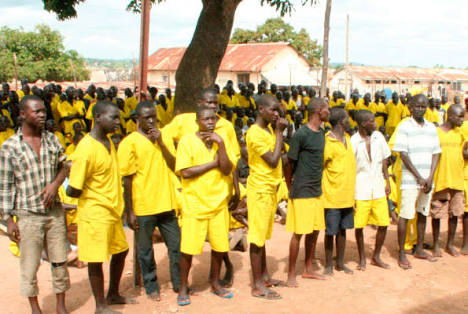

First ever national survey on Violence Against Children in Uganda launched
BUIKWE, Uganda. Three in four young adults in Uganda have experienced some form of violence during their childhood, according to Uganda’s first ever Violence Against Children Survey, launched today by the Government of Uganda and its partners.
The Uganda Violence Against Children (VAC) Survey provides nationally representative data on the prevalence, nature and consequences of physical, emotional and sexual violence against children in Uganda, and provides sub-national estimates of violence against children.
“This survey brings to light the widespread nature and problem of violence against children in the country,” said Hon. Hajat Janat Mukwaya, Minister of Gender, Labour and Social Development.
“The findings provide crucial evidence that will help guide the Government in our policy and programme decisions to better prevent and respond to violence against children across the country in the future.”
Some of the key findings from the survey include:
General findings:
3 in 4 young adults experienced some form of violence during childhood
1 in 3 young adults experienced at least two forms of violence – of either sexual, physical and emotional violence – during childhood
Half of all 18-24 year old Ugandans believe it is acceptable for a man to beat his wife
Sexual Violence
Among 18-24 year olds, 1 in 3 females (35%) and one in six males (17%) experienced sexual abuse during their childhood
1 in 4 young adults who experienced sexual abuse during childhood first experienced it at the age of 13 or younger
Children who suffered sexual abuse experienced higher mental distress than children who didn’t
Physical Violence
The majority of young adults – 6 in 10 females (59%) and 7 in 10 males (68%) – experienced physical violence during their childhood, with nearly half experiencing it at the hands of parents or adult caregivers
Among those who were subjected to physical violence by an adult, their first experience was nearly always committed by a teacher (94% for females and 86% for males)
1 in 4 children missed school after experiencing physical violence
Emotional Violence
Among 18-24 year olds, 1 in 3 experienced some form of emotional or verbal violence during their childhood
The most common perpetrator of emotional or verbal violence was a child’s mother or stepmother (41% for females and 35% for males)
Children who experience emotional violence were more likely to think of killing themselves than those who didn’t
The survey further highlights that violence against children occurs at all levels of Ugandan society – in homes, schools and communities, among other places – with survivors suffering negative physical, mental, social and cognitive consequences.
It also stresses that children who experience violence are more likely to become perpetrators of violence against children themselves in the future, fueling an inter-generational cycle of violence in the decades to come.
“The findings of this survey make it shockingly clear – Ugandan children commonly experience violence, which often harms their development and, in some instances, devastates their lives,” said Dr. Doreen Mulenga, UNICEF’s Representative to Uganda.
“This situation must therefore serve as a call to action to all people who influence children across Uganda – especially those responsible for nurturing them, such as parents and teachers – to change their attitudes from tolerating and committing violence against children to rejecting it and holding all of those who perpetrate it accountable.”
The survey was conducted by the Ministry of Gender, Labour and Social Development with support from AfriChild Centre for Excellence, ChildFund, PEPFAR, Transcultural Psychosocial Organisation Uganda (TPO), Uganda Bureau of Statistics (UBOS), USAID, the U.S. Centers for Disease Control and Prevention (CDC) and UNICEF.
Uganda is the latest among several countries such as Swaziland, Tanzania, Kenya, Zimbabwe, Haiti, Cambodia, Malawi, Nigeria, Zambia, Laos, Rwanda, Botswana, Honduras and El Salvador, that have completed data collection for similar Violence Against Children Surveys.

in 4 young adults in Uganda experienced some form of violence during their childhood
First ever national survey on Violence Against Children in Uganda launched
BUIKWE, Uganda, August 10, 2018/ — Three in four young adults in Uganda have experienced some form of violence during their childhood, according to Uganda’s first ever Violence Against Children Survey, launched today by the Government of Uganda and its partners.
The Uganda Violence Against Children (VAC) Survey provides nationally representative data on the prevalence, nature and consequences of physical, emotional and sexual violence against children in Uganda, and provides sub-national estimates of violence against children.
“This survey brings to light the widespread nature and problem of violence against children in the country,” said Hon. Hajat Janat Mukwaya, Minister of Gender, Labour and Social Development.
“The findings provide crucial evidence that will help guide the Government in our policy and programme decisions to better prevent and respond to violence against children across the country in the future.”
Some of the key findings from the survey include:
General findings:
3 in 4 young adults experienced some form of violence during childhood
1 in 3 young adults experienced at least two forms of violence – of either sexual, physical and emotional violence – during childhood
Half of all 18-24 year old Ugandans believe it is acceptable for a man to beat his wife
Sexual Violence
Among 18-24 year olds, 1 in 3 females (35%) and one in six males (17%) experienced sexual abuse during their childhood
1 in 4 young adults who experienced sexual abuse during childhood first experienced it at the age of 13 or younger
Children who suffered sexual abuse experienced higher mental distress than children who didn’t
Physical Violence
The majority of young adults – 6 in 10 females (59%) and 7 in 10 males (68%) – experienced physical violence during their childhood, with nearly half experiencing it at the hands of parents or adult caregivers
Among those who were subjected to physical violence by an adult, their first experience was nearly always committed by a teacher (94% for females and 86% for males)
1 in 4 children missed school after experiencing physical violence
Emotional Violence
Among 18-24 year olds, 1 in 3 experienced some form of emotional or verbal violence during their childhood
The most common perpetrator of emotional or verbal violence was a child’s mother or stepmother (41% for females and 35% for males)
Children who experience emotional violence were more likely to think of killing themselves than those who didn’t
The survey further highlights that violence against children occurs at all levels of Ugandan society – in homes, schools and communities, among other places – with survivors suffering negative physical, mental, social and cognitive consequences.
It also stresses that children who experience violence are more likely to become perpetrators of violence against children themselves in the future, fueling an inter-generational cycle of violence in the decades to come.
“The findings of this survey make it shockingly clear – Ugandan children commonly experience violence, which often harms their development and, in some instances, devastates their lives,” said Dr. Doreen Mulenga, UNICEF’s Representative to Uganda.
“This situation must therefore serve as a call to action to all people who influence children across Uganda – especially those responsible for nurturing them, such as parents and teachers – to change their attitudes from tolerating and committing violence against children to rejecting it and holding all of those who perpetrate it accountable.”
The survey was conducted by the Ministry of Gender, Labour and Social Development with support from AfriChild Centre for Excellence, ChildFund, PEPFAR, Transcultural Psychosocial Organisation Uganda (TPO), Uganda Bureau of Statistics (UBOS), USAID, the U.S. Centers for Disease Control and Prevention (CDC) and UNICEF.
Uganda is the latest among several countries such as Swaziland, Tanzania, Kenya, Zimbabwe, Haiti, Cambodia, Malawi, Nigeria, Zambia, Laos, Rwanda, Botswana, Honduras and El Salvador, that have completed data collection for similar Violence Against Children Surveys.






![Canon expands large format graphics production portfolio with new 3.4m Colorado XL-series Canon (www.Canon-CNA.com) today announces the Colorado XL-series, a new platform of 3.4m printers that extends the proven advantages of Canon's UVgel technology to the 3.2m graphics market. Available in hybrid and roll-to-roll configurations, the modular, field upgradable platform powered by UVgel technology delivers great versatility and exceptional productivity for both flexible and rigid media applications from signage and décor to point of sale and packaging. The Colorado XL-series comprises two easy-to-operate models: the Colorado XL7 roll-to-roll printer and Colorado XL7 hybrid printer. The new series brings the benefits of UVgel to a new market segment with exceptional application versatility across a comprehensive range of media – from banner, paper, vinyl and films to soft signage, heat-sensitive materials, foam board, fluted polypropylene, acrylic, aluminium composite boards and cardboard – providing the flexibility to tackle diverse customer requirements. With print speeds of 70m² per hour in quality mode, 106m² per hour in production mode and up to 211m² per hour in express mode, the system delivers the productivity needed for demanding production environments while accommodating substrates up to 52mm/2 inches thick for rigid applications. The new platform includes multiple technology innovations, such as the UVgel 860 ink set, which has been optimised to cover a wide variety of both rigid and flexible applications. It also provides the proven benefits of UVgel: odourless and instant-dry prints, high mechanical and chemical robustness, dimensional stability due to low-temperature curing, excellent colour consistency, TPO [1] - and VCL [2] -free, and matte and gloss finish without the need of a separate varnish. The Colorado XL-series also incorporates new UVgel 850 PrintHeads. Each printhead has 4,544 nozzles and features automated built-in nozzle performance monitoring and compensation. A single printhead supports two colours simultaneously, so that only two printheads are required to print CMYK, plus an optional third if white is configured. Additionally, the Colorado XL-series has an agile and precise printhead carriage that features UVgel DynamicMotion Control to ensure exceptional print quality even with challenging media. Taking the UV LED curing process to the next level, the Colorado XL-series introduces UVgel FullBeam Curing. This technology uses a unique 3.4-metre-wide LED curing array that, combined with an ingenious mirror system, delivers consistent UV light dosing across the entire print width, guaranteeing exceptional print uniformity over large surfaces and enabling a wider colour gamut. Media handling is optimised by the new UVgel TRIdrive vacuum belt system, which features three interactive rollers and multiple powerful vacuum zones that reduce wrinkling and skewing by automatically detecting and correcting the media positioning. This results in highly repeatable media transport through the printer, ensuring accurate positioning both longitudinally and laterally and enabling razor-sharp applications. Optional features for the Colorado XL-series, which are already available on the highly successful and modular Colorado M-series, include: UVgel White for hassle-free white printing, FLXfinish+ for creative effects using matte or gloss or mixed matte and gloss on the same print without additional varnish, and FLXture for textured finishes that mimic materials like leather, wood or fabric. Mathew Faulkner, Director, Marketing & Innovation, Wide Format Printing Group, Canon EMEA, comments: "For the past decade, Canon has been at the forefront of the inkjet evolution in large format, with market-leading technologies including the Colorado roll-to-roll printer series powered by UVgel technology and the Arizona flatbed printers. Large format print providers are looking for systems that deliver high productivity, versatile applications and reliable quality while addressing the challenge of finding skilled operators – which is why Canon is launching our new, breakthrough Colorado XL-series, an addition to our portfolio that will set a new standard in productivity and versatility. “This innovative solution brings the proven advantages of our unique UVgel technology to the 3.2m market for the first time, combining it with extensive automation and a modular design that will enable customers to extend their application possibilities into markets such as packaging and décor. Print service providers already producing high-value signage and graphics can now leverage UVgel's distinctive finishes, including mixed gloss and matte effects and textured printing, at scale to stand out in these new markets. And with its hybrid capabilities, users can print both roll-to-roll and rigid applications on the same device, using the same ink, the same colour profiles and the same unique features and finishes. For brands, for example, this translates to seamless campaigns that span the full spectrum of applications, ensuring perfect consistency across campaign assets whether they're roll-fed graphics, rigid signage, packaging, or décor elements. This is particularly valuable when these different applications appear side by side in-store, where maintaining that consistent quality and finish elevates the entire brand experience that today's brands demand." The Colorado XL-series will be available from the beginning of 2026 via Canon’s direct sales organisations as well as from accredited partners. For more information about the Colorado XL-series, please visit: https://apo-opa.co/3WltKtM](https://businessinsights.africa/wp-content/uploads/2025/10/canon_prograf-696x385.png)


![Canon makes history with 170 Million lenses milestone Canon’s RF/EF lens production exceeds 170 million units, extending its world record in interchangeable lens production Both EF and RF lenses have gained strong support from a wide range of users—from beginners to professionals—leading to steady growth in production volume Canon Inc. announced that, in October 2025, Canon reached a historic milestone of producing a cumulative total of 170 million RF and EF interchangeable lenses for its EOS series, extending its world record for the highest number of interchangeable camera lenses ever produced. The EF lens was introduced in 1987 as the dedicated lens system for Canon’s EOS autofocus single-lens reflex film camera, debuting simultaneously with the EOS system itself. Since their inception, EF lenses have led the industry by incorporating a series of world-first technologies, including the Ultrasonic Motor (USM), Image Stabilizer (IS) technology, and a multilayered Diffractive Optical (DO) element, and have undergone numerous evolutions. In 2018, Canon launched the RF lens series, designed for the EOS R mirrorless camera system, which features a large aperture, short back focus, and high-speed communication system to deliver even higher image quality. The RF and EF lens series lineup now includes a total of 108 models , covering a wide range of focal lengths from ultra-wide 10mm to super-telephoto 1200mm. The series also includes the world’s first VR lens lenses with built-in power zoom suited for video shooting, and even those compatible with power zoom adapters—expanding the scope of creative expression and meeting the diverse needs of users for both still photography and video. EF lens production began at Canon’s Utsunomiya Plant in 1987. Since then, both EF and RF lenses have gained strong support from a wide range of users—from beginners to professionals—leading to steady growth in production volume. Today, Canon manufactures lenses at five sites: Utsunomiya Plant; Canon Inc., Taiwan; Canon Opto (Malaysia) Sdn. Bhd.; Oita Canon Inc.; and Miyazaki Canon Inc. Milestones include 10 million units produced by 1995 and 50 million by 2009. Then in 2014, Canon became the first company in the world to reach 100 million interchangeable camera lenses produced. In October 2025, the company reached 170 million units, leading to the achievement of this world record. The 170 millionth lens produced was the RF 70-200mm F2.8 L IS USM Z. Canon has maintained the No.1 global market share for digital interchangeable-lens cameras for 22 consecutive years since 2003. Moving forward, Canon will continue to refine its proprietary imaging technologies and further strengthen and expand its lens lineup, pioneering new imaging possibilities and contributing to the continued evolution of photographic and video culture. Highlights in the development of the RF/EF Lens Series The EF lens, which was introduced alongside EOS in March 1987, has adopted a variety of world-first technologies, including Image Stabilizer (IS) technology, featured in the EF 75-300mm f/4-5.6 IS USM released in 1995; a multilayered Diffractive Optical (DO) element, used in the EF 400mm f/4 DO IS USM launched in 2001; and Subwavelength Structure Coating (SWC) [7], applied to the EF 24mm f/1.4L II USM released in 2008. In 2021, Canon launched the EOS VR System, a VR video system consisting of a mirrorless camera [8], dedicated lens, and PC software, thereby creating a 3D 180° VR video through an interchangeable lens camera. In 2024, Canon began rolling out a new series of hybrid lenses equipped with iris rings, designed to meet the needs of both still photography and professional video production. For zoom lenses, the company has also launched RF 24-105mm F2.8 L IS USM Z and RF 70-200mm F2.8 L IS USM Z which are compatible with power zoom adapters. For single focus lenses, the company released F1.4 L hybrid prime lens series that unified the size and ring and button position across models. In September 2025, Canon launched RF 85mm F1.4 L VCM, the fifth model in this series, demonstrating that it can meet demands in line with the changing times. [1] Includes EF, EF-S, EF-M, EF Cinema, RF, RF-S, and RF Cinema lenses and extenders. As of October 21, 2025 (according to a survey by Canon) [2] Among SLR cameras (according to a survey by Canon) [3] Number of products sold as of October 22, 2025 (including extenders). The number of lens models for sale is different according to market figures. [4] Focal length is 5.2mm to 1200mm when including VR lenses [5] An interchangeable digital camera lens that enables VR footage with a single camera. Among interchangeable lens digital cameras released as of October 5, 2021 (according to a survey by Canon) [6] Refers to unit share (according to a survey by Canon) [7] A special coating with advanced anti-reflective properties [8] For applicable cameras, please visit the official Canon website *Release dates in this document refer to dates in Japan. Canon Central and North Africa (CCNA) is a division within Canon Middle East FZ LLC (CME), a subsidiary of Canon Europe. The formation of CCNA in 2016 was a strategic step that aimed to enhance Canon’s business within the Africa region - by strengthening Canon’s in-country presence and focus. CCNA also demonstrates Canon’s commitment to operating closer to its customers and meeting their demands in the rapidly evolving African market. Canon has been represented in the African continent for more than 15 years through distributors and partners that have successfully built a solid customer base in the region. CCNA ensures the provision of high quality, technologically advanced products that meet the requirements of Africa’s rapidly evolving marketplace. With over 100 employees, CCNA manages sales and marketing activities across 44 countries in Africa. Canon’s corporate philosophy is Kyosei – ‘living and working together for the common good’. CCNA pursues sustainable business growth, focusing on reducing its own environmental impact and supporting customers to reduce theirs using Canon’s products, solutions and services. At Canon, we are pioneers, constantly redefining the world of imaging for the greater good. Through our technology and our spirit of innovation, we push the bounds of what is possible – helping us to see our world in ways we never have before. We help bring creativity to life, one image at a time. Because when we can see our world, we can transform it for the better.](https://businessinsights.africa/wp-content/uploads/2026/05/1.-Canon-EOS-R50-Mirrorless-Camera-for-Beginners-1024x764-1-100x70.jpg)