
He trains other farmers on organic farming methods
By Special Correspondent
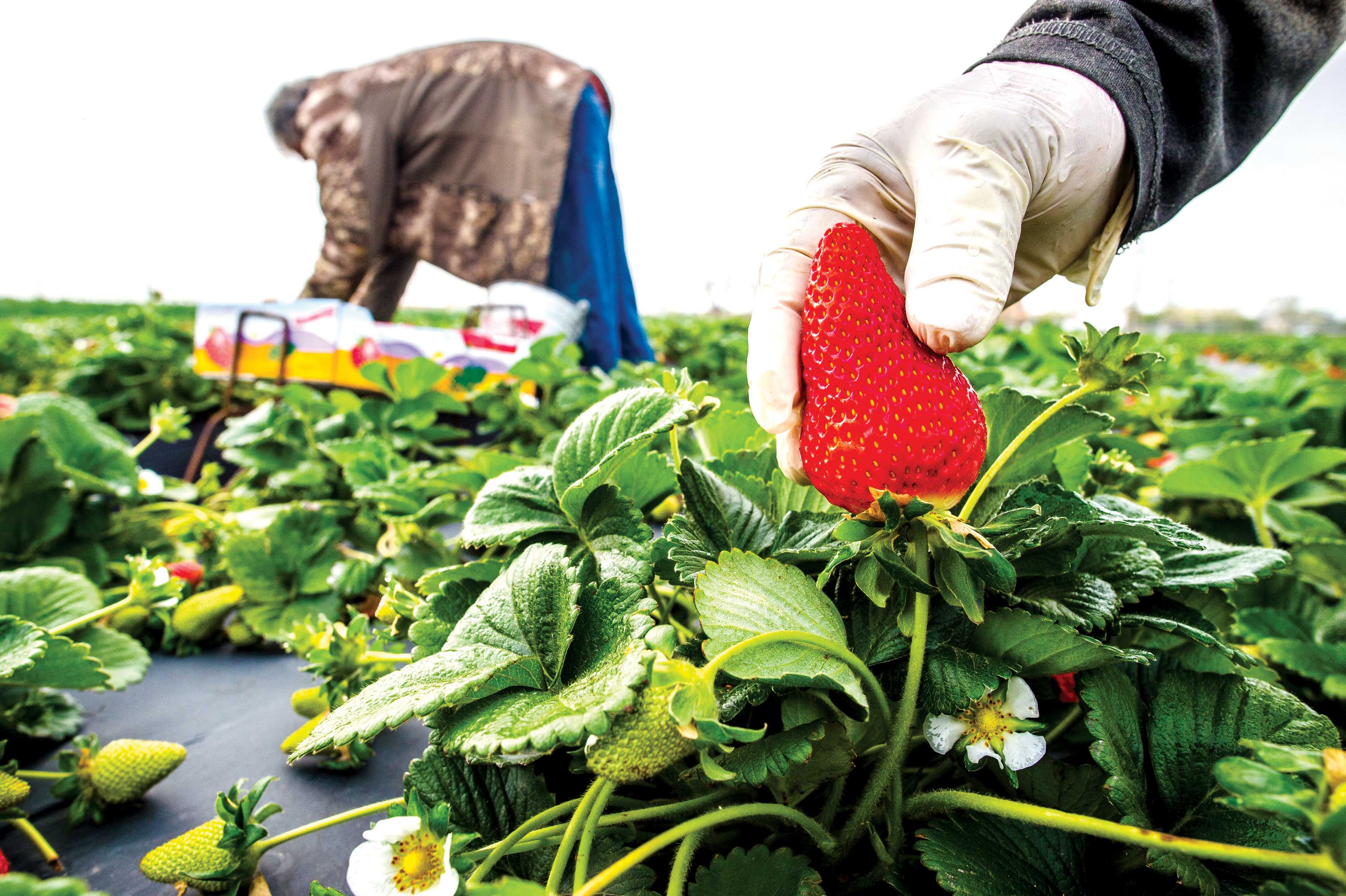
To many Kenyans, strawberries are just fruits, but to Njoroge Kibe, they are his business. A Kiambu resident, Njoroge started farming strawberries five years ago. Today, he is a major producer of the fruits. Unlike many other farmers who grow conventional strawberries, Njoroge takes pride in being among the few farmers producing organic strawberries.
When he ventured into strawberry farming, he realized that most strawberry farmers were using chemicals to propagate the plants, leading to low quality fruits.
As a young farmer, he chose the unbeaten path of organic farming. And he has never looked back.
In his quarter of an an acre piece of land in Uthiru, rows and rows of green strawberry plants line up his small shamba. While strawberry farming helps him earn his daily bread, training farmers on the best practice for growing strawberries gives him joy and satisfaction.
“I like seeing others succeed. I love sharing my knowledge with others,” he says.
By opening his doors to many other farmers, he unknowingly expanded his farming business. It was a blessing because after the trainings, the new farmers help him meet the high demand for the fruit.
“Together with the new farmers, we can meet any demand for the fruits. When I’m doing it alone, I cannot satisfy the market, which keeps growing.”
Strawberries are mostly sold in punnets and eaten as fruits. Most companies are now adding value to the fruits by creating fruit jam.
His small shamba produces over 40 kilos of strawberries every week. While he occasionally gets orders of up to 150 kilos of fruits per week, he never worries about the produce, as the new farmers easily help him meet the deficit. Other than this, he makes some money through trainings.
“Every Saturday, I train up to 15 people on a good day. I charge Kes1500 for the three-hour sessions, after which the new farmers are ready to go and start strawberries farming.”
Looking at Njoroge explain a few farming concepts to his trainees, one wonders how the youthful man found himself in the agribusiness sector. Is it passion or does he do it out of curiosity.
“My entry into farming was motivated by a TV program on farming. After watching the show, I partnered my brother and together we started the farming venture.”
Njoroge’s journey started when they visited the KARI offices to learn more about strawberry farming. After the training, which was nothing more than an introduction, he was ready to start commercial farming.
“We bought our first seedlings for Kes20,000d after a few months, they dried up. Little did we know that we had bought substandard seedlings, “he says of the ordeal that left him counting losses.
For Njoroge, a former poultry farmer, any loss was a bad loss, the reason he decided to search for a practical trainer with an aim of perfecting the rigors of his new venture.
Together with his brother, Njoroge visited a strawberry farmer in Limuru, where they learnt all it takes to be successful in strawberry farming.
“The training was practical and impactful. After the training, we felt we were now ready to do serious strawberry farming,” he adds. The venture kicked off earnestly. Before long, he realized that the demand for the fruits was huge, prompting him to look for other farmers to help him meet the demand.
“I realized that training farmers to do organic farming was way impactful than contracting existing farmers to supply what they produced. First, I had the assurance that a newly trained farmer could only provide organic produce.”
How do organic strawberries differ from conventional ones? According to him, organically farmed strawberries are big in size, are fresh and juicer than chemically farmed strawberries. They also fetch good prices in the market.
He didn’t want to compromise on the quality of his produce. This led him to train as many farmers as he could. Together, the farmers marshal their energy to produce organic strawberries. It has since paid off.
“I have expanded and I have another small piece of land in Kitengela where I farm strawberries.”
Why are trainings necessary?
“You can easily know which farmer has been trained by looking at their producel.”
Njoroge says that there are many challenges facing strawberry farmers, some of which can only be solved when farmers come into contact with experienced farmers,
Pests and diseases is one of these. When a farmers hasn’t been trained, detecting pests or diseases and eliminating them becomes an arduous task.
“If you already know everything about strawberries, farming becomes easy and rewarding>’
Another challenge that farmers grapple with is poor quality seedlings.
According to Njoroge, some framers use splits and others use runners. Splits are clones from old plants and are not usually of high quality while runners are the first generation plants from the mother plants. While splits can do well for one year, their quality deteriorates after one year. Runners can yield good results for up to three years. Strawberries can be propagated using seeds, but few farmers use this method.
“Farmers are only experimenting with seeds. Not many want to try seed because there’s a lot of work involved.”
What does one need to start?
Njoroge says that all that is required is a small piece of land, lots of water, quality strawberry seedlings and some courage to start a business. “People should never say that they don’t have land. A small piece, say a quarter of an acre, can hold up to two hundred strawberry plants if the best methods of farming are deployed.”
Like many other crops, strawberry farming has its own share of challenges. First, the plants need lots of water as a huge percentage of the fruits is made up of water.
The other key challenge is erratic weather, Strawberries do well in places with warm climate. Given the recent heavy rains in the country, strawberry farmers are counting losses.
However, strawberry farming is easy and straightforward. After planting, the plants only need periodic watering, mostly in the morning and evening. After the first one month, the watering frequency goes down, freeing up the farmer’s time. I
“It’s not practical to stay in the farm from morning to evening. Strawberries don’t need lots of attention. The best thing about them is they give you fruits every week for up to three years.”
In the next five years, Njoroge says he would be exporting the fruits to different markets across the globe. Given the rising demand for organic strawberries, his dream is valid.










![Canon makes history with 170 Million lenses milestone Canon’s RF/EF lens production exceeds 170 million units, extending its world record in interchangeable lens production Both EF and RF lenses have gained strong support from a wide range of users—from beginners to professionals—leading to steady growth in production volume Canon Inc. announced that, in October 2025, Canon reached a historic milestone of producing a cumulative total of 170 million RF and EF interchangeable lenses for its EOS series, extending its world record for the highest number of interchangeable camera lenses ever produced. The EF lens was introduced in 1987 as the dedicated lens system for Canon’s EOS autofocus single-lens reflex film camera, debuting simultaneously with the EOS system itself. Since their inception, EF lenses have led the industry by incorporating a series of world-first technologies, including the Ultrasonic Motor (USM), Image Stabilizer (IS) technology, and a multilayered Diffractive Optical (DO) element, and have undergone numerous evolutions. In 2018, Canon launched the RF lens series, designed for the EOS R mirrorless camera system, which features a large aperture, short back focus, and high-speed communication system to deliver even higher image quality. The RF and EF lens series lineup now includes a total of 108 models , covering a wide range of focal lengths from ultra-wide 10mm to super-telephoto 1200mm. The series also includes the world’s first VR lens lenses with built-in power zoom suited for video shooting, and even those compatible with power zoom adapters—expanding the scope of creative expression and meeting the diverse needs of users for both still photography and video. EF lens production began at Canon’s Utsunomiya Plant in 1987. Since then, both EF and RF lenses have gained strong support from a wide range of users—from beginners to professionals—leading to steady growth in production volume. Today, Canon manufactures lenses at five sites: Utsunomiya Plant; Canon Inc., Taiwan; Canon Opto (Malaysia) Sdn. Bhd.; Oita Canon Inc.; and Miyazaki Canon Inc. Milestones include 10 million units produced by 1995 and 50 million by 2009. Then in 2014, Canon became the first company in the world to reach 100 million interchangeable camera lenses produced. In October 2025, the company reached 170 million units, leading to the achievement of this world record. The 170 millionth lens produced was the RF 70-200mm F2.8 L IS USM Z. Canon has maintained the No.1 global market share for digital interchangeable-lens cameras for 22 consecutive years since 2003. Moving forward, Canon will continue to refine its proprietary imaging technologies and further strengthen and expand its lens lineup, pioneering new imaging possibilities and contributing to the continued evolution of photographic and video culture. Highlights in the development of the RF/EF Lens Series The EF lens, which was introduced alongside EOS in March 1987, has adopted a variety of world-first technologies, including Image Stabilizer (IS) technology, featured in the EF 75-300mm f/4-5.6 IS USM released in 1995; a multilayered Diffractive Optical (DO) element, used in the EF 400mm f/4 DO IS USM launched in 2001; and Subwavelength Structure Coating (SWC) [7], applied to the EF 24mm f/1.4L II USM released in 2008. In 2021, Canon launched the EOS VR System, a VR video system consisting of a mirrorless camera [8], dedicated lens, and PC software, thereby creating a 3D 180° VR video through an interchangeable lens camera. In 2024, Canon began rolling out a new series of hybrid lenses equipped with iris rings, designed to meet the needs of both still photography and professional video production. For zoom lenses, the company has also launched RF 24-105mm F2.8 L IS USM Z and RF 70-200mm F2.8 L IS USM Z which are compatible with power zoom adapters. For single focus lenses, the company released F1.4 L hybrid prime lens series that unified the size and ring and button position across models. In September 2025, Canon launched RF 85mm F1.4 L VCM, the fifth model in this series, demonstrating that it can meet demands in line with the changing times. [1] Includes EF, EF-S, EF-M, EF Cinema, RF, RF-S, and RF Cinema lenses and extenders. As of October 21, 2025 (according to a survey by Canon) [2] Among SLR cameras (according to a survey by Canon) [3] Number of products sold as of October 22, 2025 (including extenders). The number of lens models for sale is different according to market figures. [4] Focal length is 5.2mm to 1200mm when including VR lenses [5] An interchangeable digital camera lens that enables VR footage with a single camera. Among interchangeable lens digital cameras released as of October 5, 2021 (according to a survey by Canon) [6] Refers to unit share (according to a survey by Canon) [7] A special coating with advanced anti-reflective properties [8] For applicable cameras, please visit the official Canon website *Release dates in this document refer to dates in Japan. Canon Central and North Africa (CCNA) is a division within Canon Middle East FZ LLC (CME), a subsidiary of Canon Europe. The formation of CCNA in 2016 was a strategic step that aimed to enhance Canon’s business within the Africa region - by strengthening Canon’s in-country presence and focus. CCNA also demonstrates Canon’s commitment to operating closer to its customers and meeting their demands in the rapidly evolving African market. Canon has been represented in the African continent for more than 15 years through distributors and partners that have successfully built a solid customer base in the region. CCNA ensures the provision of high quality, technologically advanced products that meet the requirements of Africa’s rapidly evolving marketplace. With over 100 employees, CCNA manages sales and marketing activities across 44 countries in Africa. Canon’s corporate philosophy is Kyosei – ‘living and working together for the common good’. CCNA pursues sustainable business growth, focusing on reducing its own environmental impact and supporting customers to reduce theirs using Canon’s products, solutions and services. At Canon, we are pioneers, constantly redefining the world of imaging for the greater good. Through our technology and our spirit of innovation, we push the bounds of what is possible – helping us to see our world in ways we never have before. We help bring creativity to life, one image at a time. Because when we can see our world, we can transform it for the better.](https://businessinsights.africa/wp-content/uploads/2026/05/1.-Canon-EOS-R50-Mirrorless-Camera-for-Beginners-1024x764-1-100x70.jpg)